

[Author Disclosure: This content reflects the views of the author and is provided for informational purposes only. It does not constitute investment advice and is not a recommendation or endorsement by BioTech Funding Portal. Any investment decision should be based solely on the issuer’s official offering materials.]
4 scientists in the FDA office reviewed gene therapies and published something unusual this month. They went back through the questions the agency asked sponsors while reviewing the gene therapies it has approved, counted them, sorted them by subject, and published the result.
For a company like ours, still working toward its first trial, this is a rare look at where the hard part of approval actually sits.
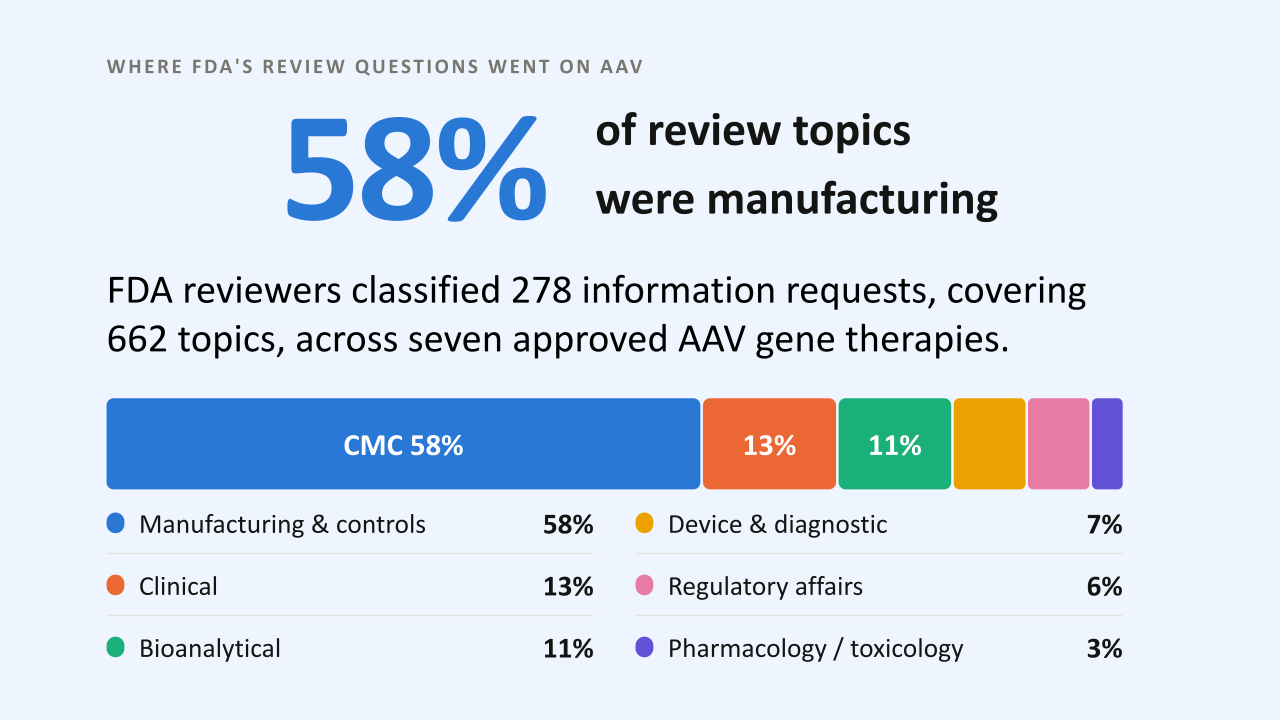
The headline finding: 58 percent of the questions FDA asked were about manufacturing.
What the analysis looked at
Some plain definitions first.
A BLA is the application a company files to get a product approved for sale. Before that, a company files an IND, which is the application to begin testing in people. Glafabra is at the stage just before the IND, which is why we describe ourselves as pre-IND.
While FDA reviews a BLA, it sends the company written questions called information requests. These are confidential for any individual product. What the FDA authors did was pool them across products, strip out the identifying detail, and count the topics.
CMC stands for chemistry, manufacturing and controls. In plain terms it is the whole body of evidence you have to show you can make the product consistently, measure it accurately, and prove that what goes into the patient today is the same as what will be used the months and years after that.
The authors examined 278 information requests covering 662 separate topics, across seven approved AAV gene therapies licensed between 2017 and 2025.
What they found
Of the 662 topics:
- 58 percent were manufacturing and controls
- 13 percent were clinical
- 11 percent were laboratory tests run on patient samples
- 7 percent were devices and diagnostics
- 6 percent were regulatory paperwork
- 3 percent were animal safety studies
Three further findings matter as much as the headline:
- The work does not end at approval. Nearly every approved product left the review with a list of follow-up obligations, a median of six per product, mostly manufacturing, each taking two to four years to finish.
- Early questions predicted later burden. Products that drew more manufacturing questions during review carried more follow-up obligations afterward. Products with well-defined measurement methods and settled processes finished faster.
- Readiness is improving. Companies filing more recently drew fewer questions than the earliest applicants, with the steepest improvement in manufacturing.
Why this is harder for a cell therapy than for the products studied
The products in this analysis are AAV gene therapies, where AAV stands for adeno-associated virus. These are delivered by infusion or injection directly into the patient, and they are made in large batches, like a conventional drug.
Glafabra's approach is different in a way that matters here. Live-cel collects a patient's own blood stem cells, corrects them outside the body using a lentiviral vector, and returns them to that same patient. That means two things have to be manufactured and controlled rather than one:
- The vector, which is a complex biological product in its own right, with its own purity, potency and safety testing.
- The cell product, where a batch is made for one patient and is used only by that patient.
Several consequences follow. Specifications have to cover both the vector and the cells. Variability starts with the patient, since how many stem cells a given person yields differs from person to person. And keeping track of whose cells are whose becomes a quality requirement, not just good practice.
None of this is unique to Glafabra. It is the structure of every autologous cell therapy. But it means the 58 percent figure is, if anything, a floor of concern for our modality, rather than a ceiling.
What this means for Glafabra specifically
Our timeline is already built around the importance of manufacturing. As a result, our IND timing depends mainly on manufacturing readiness. Our business plan states that the GMP lentiviral vector manufacturing campaign begins in 2027 and that IND submission follows approximately twelve to fifteen months after that campaign starts. In other words, the clock to the clinic starts when the vector campaign starts. In our view, the analysis is consistent with that sequencing.
We have a grant proposal in review aimed squarely at this work. On 8 September 2026 Glafabra submitted a Direct-to-Phase II SBIR application to the NIH under PA-27-100, titled "GT-GLA-S03 (Live-cel): IND-Enabling Development of a Cell-Based Gene Therapy for Fabry Disease," requesting $2,999,715 over a two-year project period. SBIR funding is non-dilutive, meaning it does not involve selling equity. The three aims read almost as a direct response to what this FDA analysis identifies as the hard part:
Aim 1 compares at least two vector plasmid designs head to head in donor stem cells, measuring both vector copy number and alpha-galactosidase A activity, then locks the design and moves into cGMP vector manufacture. It is designed to address the potency measurement question before the clinic, rather than during review.
Aim 2 transfers the FACTS-derived cell process onto a closed, automated manufacturing platform and uses qualifying engineering runs to establish reproducibility, critical quality attributes, potency and IND-stage release criteria. Engineering runs are designed to address the specification problem described above, because they produce batches to set limits, without spending precious patient samples to do it.
Aim 3 completes the nonclinical genotoxicity package, evaluated by integration-site and clonal-dominance analysis. That is the work FDA asked for at our INTERACT meeting.
The budget is driven by purchased cGMP manufacturing rather than by salaries, which is what you would expect of a proposal whose purpose is to buy manufacturing readiness, where vector and plasmid supply are contracted separately from drug product manufacture. One caveat matters: this application is in review. SBIR awards are competitive and there is no assurance of funding. If awarded, it would cover a substantial share of the IND-enabling CMC work without diluting shareholders. If it is not awarded, that work is funded, in part, from the raise.
Much of the Regulation Crowdfunding raise is intended for manufacturing and regulatory work. Proceeds from the planned $1M Regulation Crowdfunding raise are intended to fund early manufacturing comparability studies. Glafabra expects the work through the first clinical trial to cost approximately $25M, well beyond this raise, so we will need to raise substantial additional capital to fund it. As a result, Glafabra will soon be raising capital in a Series A financing under Rule 506(c), which is open only to verified accredited investors and is not offered through BioTech Funding Portal. This testing-the-waters campaign relates only to the planned Regulation Crowdfunding offering.
Our manufacturing partner selection is deliberately timed, not deferred. The plan gates selection of the drug product CDMO to the start of the vector campaign, so that capacity is reserved against a real batch schedule rather than a projected one. The criteria are set: an automated closed-system platform suited to a single-patient batch, demonstrated CD34+ stem cell capability, US domicile, and GMP capacity aligned to the vector campaign.
Potency is the measurement we have to get right early. Potency means proving the product does what it is supposed to do. For us that is the corrected cells producing sufficient amounts of working alpha-galactosidase A enzyme. The FDA analysis found potency to be among the most frequent question topics and among the most common post-approval obligations. Separately, FDA finalized its potency guidance for cell and gene therapy products on 2 November 2026, and it asks companies to show a relationship between what they measure in the product and the effect in the patient. In a rare disease trial with a small number of patients, that relationship can only be built from the patients you actually treat, which means it has to be designed in from the first patient rather than assembled later. We have a useful starting point here: at our INTERACT meeting on 16 July 2026, FDA agreed that plasma lyso-Gb3 is the appropriate pharmacodynamic readout for our program. INTERACT feedback is preliminary and non-binding, and FDA’s views may change as the program develops. However the use of lyso-Gb3 with enzyme activity readout gives us the patient-side measurement to pair with the product-side one.
The platform argument is, in our view, consistent with the analysis. At the same INTERACT meeting, FDA indicated that CMC and manufacturing knowledge from our Fabry program may be leveraged across follow-on programs where the vector backbone, packaging, process and cell-processing steps are conserved, with each transgene advancing under its own IND. The new analysis shows why that is worth money and not just time: products with well-defined assays and settled processes closed their post-approval obligations faster. The practical implication for us is that our assays should be built to be shared across Fabry, Pompe and Gaucher, with only the potency assay specific to each disease.
One cost is disclosed and not yet quantified. Our plan states we intend to qualify a second drug-product manufacturing source ahead of the registrational phase, and states plainly that this second source is not yet costed. The FDA analysis is a reminder that any such change triggers a comparability exercise, which is its own body of work. So we will need to choose wisely on manufacturing sources.
One structural difference matters here. Six of the eight AAV products in the analysis needed a companion diagnostic or a specialized device, most often a blood test to screen out patients who already carry antibodies against the viral capsid. Those tests bring their own review burden. Because Live-cel modifies the patient's own cells outside the body rather than delivering a virus into the patient, there is no capsid, so there is no such screening test to co-develop. For context, roughly 40 percent of adults test positive for antibodies against AAV6, the capsid used by an AAV Fabry program in development, and those patients are excluded from treatment. We are not device-free, though. Apheresis equipment, closed cell-processing systems and cold-chain logistics all sit inside our eventual review, and we should map that early rather than assume it away.
Also a long tail to the study needs to be in the budget. Because our vector integrates into the cell's DNA, FDA guidance calls for up to 15 years of patient follow-up. FDA has already told us, at INTERACT, that an in vitro immortalization assay and integration-site analysis are expected in the IND. These are known and planned obligations, but they are also multi-year costs that belong in any realistic model of what this program requires, and in the diligence of any future partner.
What this analysis does not say
Several points of balance are worth stating plainly.
- It is about a different modality. All eight products studied are AAV gene therapies given directly to the patient. None are autologous cell therapies. Everything in the section above is our reading of how the findings carry across, not a finding of the paper itself.
- It is a small sample from the approval stage. Seven BLAs, and the underlying request data are internal to FDA. We are pre-IND. The nearest-term relevance to us is discipline at the IND stage. But it will carry to the BLA stage, which is years away.
- Manufacturing problems are a genuine risk, not a theoretical one. Two cell and gene therapy applications received complete response letters from FDA in 2024 on manufacturing and release testing methods, with no clinical or efficacy concerns raised in either case. Both products were approved later, but each lost a year or more. Any company in this field, Glafabra included, carries that risk.
- Integrating vectors carry a safety question that AAV does not. Because the vector inserts into the cell's DNA, there is a theoretical and, in one approved product, an observed risk of blood cancers arising years after treatment. That risk is not uniform across products and depends heavily on how the vector is designed. In the co-founder-run FACTS proof-of-concept study in Canada, insertion-site analysis of all five patients found a polyclonal pattern with no evidence of clonal dominance or leukemic transformation (PMID 36816757). Five patients is a small number, and long-term follow-up is exactly why FDA calls for up to 15 years of it.
Where this leaves us
The useful conclusion from this analysis is not that approval is harder than we thought. It is that the hard part is more predictable than it is often made out to be, and that it is mostly manufacturing. The companies that drew fewer questions were the ones whose measurement methods and processes were settled before they filed.
Glafabra is pre-IND. The FACTS trial was conducted by our co-founders under Canadian regulatory oversight and is proof of concept for the platform, not a Glafabra trial. The work directly ahead of us is the GMP vector campaign, the CMC package, and the IND filing. We have pursued two funding routes for that work in parallel, the Regulation Crowdfunding raise and the Direct-to-Phase II SBIR application now in review, because it is the part of the program that determines when we reach patients. This analysis sharpens where that effort should concentrate. In our view, it is also consistent with a sequencing choice we had already made.
Source: Bing S, Argaw T, Kaushal M, Mazor R. "Regulatory lessons from FDA review of approved AAV gene therapies." Nature Reviews Drug Discovery, 6 November 2026, doi:10.1038/d41573-026-00178-3, and its supplementary information. Forward-looking statements about timelines, costs and regulatory outcomes are plans and expectations, not commitments, and are subject to change.
This Live-cel is an experimental treatment that has not been approved by the FDA or any other regulator. Glafabra is considering a capital raise and we are "Testing the Waters" under Regulation Crowdfunding. No money or other consideration is being solicited, and any sent in response will not be accepted. We cannot accept any offer to buy securities, and no part of the purchase price can be received, until an offering statement is filed and only through the BioTech Funding Portal platform. Any indication of interest is non-binding and involves no obligation or commitment of any kind.
Register for FREE to comment or continue reading this article. Already registered? Login here.
0