
[Author Disclosure: This content reflects the views of the author and is provided for informational purposes only. It does not constitute investment advice and is not a recommendation or endorsement by BioTech Funding Portal. Any investment decision should be based solely on the issuer’s official offering materials.]
Your own cells, designed as a durable enzyme source
Information for people living with Fabry disease and their families. It is not investment information. Glafabra Therapeutics, October 2026. Live-cel is an experimental treatment. It is not approved by the FDA or any other regulator.
The problem Live-cel is trying to solve
In Fabry disease, a change in the GLA gene means the body does not make enough of an enzyme called alpha-galactosidase A. Without it, a fatty substance called Gb3, and a related form called lyso-Gb3, builds up inside cells of the kidneys, heart, nerves and blood vessels.
The standard of care is enzyme replacement therapy (ERT), which supplies the missing enzyme by infusion, every two weeks. It is effective for many patients. The infused enzyme levels rise after each infusion and fall below therapeutic levels before the next infusion (PMID 39794302). Many patients describe living their lives in two-week increments.
Live-cel is studying a different approach: Using your own cells, once corrected, to make the enzyme continuously from inside your body.
The four steps of Fabry stem cell therapy
Collect. A medicine moves blood stem cells out of your bone marrow and into your bloodstream. They are then collected through apheresis, a process in which blood passes through a machine that keeps the stem cells and returns the rest of your blood, similar to donating platelets.
Correct. In a specialized laboratory, your stem cells receive a working copy of the GLA gene. The gene is carried into the cells by a lentivirus that has been modified so it cannot cause infection; it serves only as a delivery vehicle. The working gene becomes a permanent part of each corrected cell, so it is passed on to every cell that the stem cell produces. In Live-cel, the lentivirus is used only in manufacturing. It is not injected into your body; only your own corrected cells are returned.
Prepare. Before your cells are returned, a low dose of a medicine called melphalan makes room for them in the bone marrow. This is a much lower dose than the preparation for a full bone marrow transplant. In the first study, four of five patients completed this step as outpatients and went home the same day. Melphalan has known side effects, including suppression of your immune system, which a care team would review in full before anyone decides to take part.
Return. Your corrected cells are given back through an IV, much like a blood transfusion. They travel to the bone marrow and settle there, in a process called engraftment.
Why it is designed to last years
Stem cells renew themselves. Blood stem cells live in the bone marrow for years, making copies of themselves and producing a steady supply of new white blood cells. Once a corrected stem cell has settled in, each new white blood cell it makes carries the working gene.
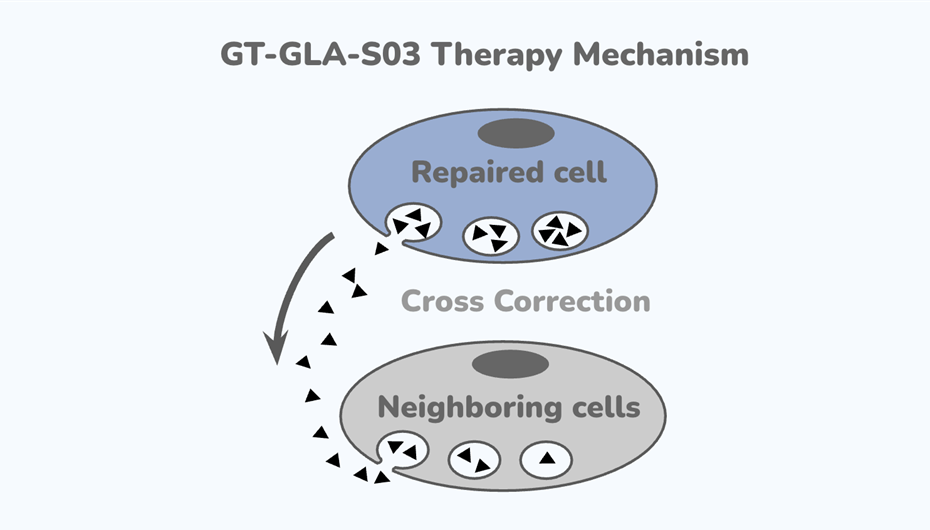
The enzyme reaches tissues from the inside. White blood cells circulate through the body and move into tissues, where they release the enzyme. Neighboring cells take it up and use it to break down the built-up Gb3. This sharing between cells is called cross-correction, and it relies on the same uptake route that allows infused ERT to work.
Steady, not cyclical. Because the corrected cells keep producing enzyme, the design goal is a steady level rather than the rise and fall of an infusion cycle. Whether Live-cel achieves this will be studied in the next trial.
They are your own cells. There is no donor, so there is no donor matching and no risk of your body rejecting someone else's cells.
If enzyme levels fall over time
Enzyme levels from a single treatment may decline over the years. Live-cel is designed so it can be given again if that happens. Because no virus is injected into the body, Glafabra expects that a second treatment would not be blocked by antibodies to the virus. Repeat treatment will be studies in the upcoming trial, where the when and how a repeat treatment is still being worked out with the FDA. ERT also remains available to anyone who needs it after Glafabra’s stem cell treatment.
What the first study showed
The approach behind Live-cel was first tested in the FACTS study, a five-patient study in Canada led by Glafabra's co-founders and run under Canadian regulatory oversight. Five adult men with Fabry disease were followed for five years after a single treatment.
- All five still had therapeutic enzyme levels at five years.
- Plasma lyso-Gb3 fell by about half (48%) compared with levels measured while off ERT.
- Three of five chose to stop ERT. All three remained off ERT at five years. One of these three patients later restarted ERT, after the five-year study ended, on his doctor's advice when his lyso-Gb3 levels rose.
- In five years of follow-up, no serious adverse events were judged to be related to the treatment. The study was too small to establish Live-cel's safety.
- Two of the 5 patients were interviewed and they respondee they would choose Live-cel again over returning to ERT.
"At one point my wife and I realized we were forgetting I had Fabry at all." Ryan, FACTS participant.
Five patients is a small study. However the published 5 year followup demonstrated the approach can work and last (PMID 39794302). However it does not establish the full safety profile and neither does it does show that Live-cel is better than ERT. Answering those questions is the purpose of the next study.
Where things stand today
Glafabra met with the FDA in July 2026 to discuss the program and is preparing to ask the FDA for permission to begin a U.S. clinical study. It expects to submit that request (an IND) in late 2027 and to begin enrolling patients in 2028, potentially at University of Utah Health and other sites. These plans may change.
The study is not yet open, and who will be eligible has not been decided. Fabry disease in women is real and serious, and early intervention is key to good outcome. So, Glafabra is listening to patients and advocates on what an ideal therapy can do by forming a patient advisory board now.
Please do not stop or change your current treatment. If you are interested, the best first step is a conversation with your Fabry specialist, so you are ready to evaluate the study once eligibility is announced.
Register for FREE to comment or continue reading this article. Already registered? Login here.
0