
[Author Disclosure: This content reflects the views of the author and is provided for informational purposes only. It does not constitute investment advice and is not a recommendation or endorsement by BioTech Funding Portal. Any investment decision should be based solely on the issuer’s official offering materials.]
One hundred and twelve. I first heard the number in a small conference room at Beijing Children’s Hospital, packed with Chinese physicians and a handful of Western guests. Since Decree No. 818 took effect on May 1st, 2026, roughly 1100 investigator-initiated trials (IITs) had been filed across China. By mid-September, 112 had been cleared.
I had landed the day before for the 3rd annual meeting of the Chinese Society of Cell and Gene Therapy (CSGCT), and I was staying on for a CSGCT-organized tour of top hospitals, research centers, and manufacturers around the country. The point of the trip was to see for myself what Decree No 818, the new Chinese national framework governing how IITs are approved and run, had actually evolved on the ground. The trade press I’d been reading had prepared me for a wild west. The current ten percent clearance rate did not sound like a wild west. It sounded like a system in the middle of a hard correction.
I didn’t understand the magnitude of this correction until our group visited Chengdu. West China Hospital at Sichuan University is a massive, roughly 5,000-bed institution, one of 1,700 Tier “3A” hospitals in the country. A presentation slide reported 1080 interventional IITs were initiated in that one hospital alone in 2025. That number far exceeds the number of IITs cleared across all of China in the four and a half months since 818 came into effect. This matched what I had heard in numerous conversations: by enacting 818, the Chinese government had acted decisively, and far fewer IITs were starting as a result.
Why I went
Dyno is a genetic technology and partnership company. We engineer AAV capsids using AI and license them to gene therapy developers – the teams doing the hard work of delivering new therapeutic options to patients. We do not commercialize these therapies ourselves, so our business only succeeds when our partnerships succeed and patients gain more options to act. Doing that at scale advances genetic agency: an individual’s ability to take action at the genetic level to live a healthier life. The scientific innovation we need for this future is largely in place. What is missing is regulatory innovation, in every country. That is why I wanted to understand the post-818 regime firsthand. If it gives our partners an advantage in bringing options to patients, and makes more diseases developable, we need to know how it works so we can help them navigate it.
What we’d been told before I visited China
The deaths reported by US media in Chinese IITs this summer were deeply unsettling: a six-year-old girl with Snijders Blok-Campeau syndrome (spring 2025), a boy with Duchenne Muscular Dystrophy (August 2025), and a man with Systemic Sclerosis (March 2026). In the girl’s case, both scientific and ethics committees of the hospital approved the trial prior to when primate toxicity data was fully available that showed serious liver injury. The first two patients died at least a year before US media broke the news. The questions these deaths surfaced: are they the tip of the iceberg? Should the cases have been reported to the scientific community earlier? The company behind the man’s therapy issued a press release about starting a US trial without mentioning his death. Without reliable public channels to report serious adverse events and deaths, the IIT system exposes patients and developers to unacceptable risks.
Decree No. 818
The problems in the coverage were real, and they were problems the Chinese government had already moved to fix. Decree No. 818 was passed by the State Council on September 12, 2025, and signed on September 28, 2025, before any of the three deaths were known outside China. All three trials were approved under the old system. To give institutions time to adapt, 818 took effect on May 1, 2026, with rules that raised the standards for IITs and sharply cut the number being started. Here are a few of the most consequential:
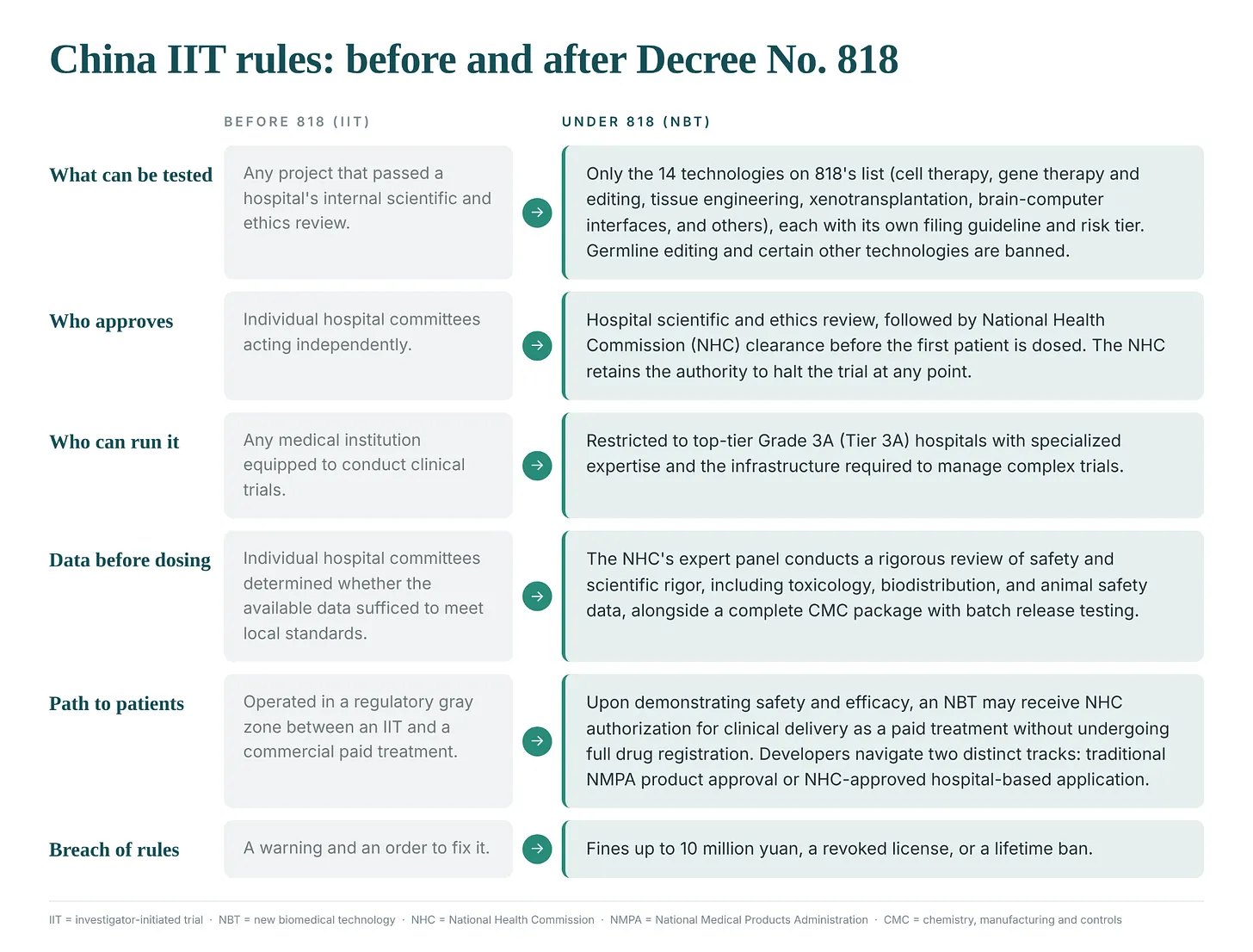
For many of the Chinese developers I spoke with, these rules have made it less clear which path fits their development plans best, when before an IIT was often the obvious first step. The cost and time advantage an IIT held over a Chinese Investigational New Drug (IND) application has narrowed, but not closed. By restricting which technologies qualify in the first place, Decree 818 will undoubtedly lead to far fewer IITs moving forward. Those trials that do launch will be more rigorous and focused on advanced therapies, effectively weeding out the lower-standard, high-risk, pay-to-play (some, not all) models of the past. Paired with another component of China's medical innovation system, one I had not encountered before this trip, these reforms have the potential to significantly expand patient options.
Boao Lecheng Pilot Zone
IITs, and their overhaul under Decree No. 818, have gotten most of the attention. But there is a second patient access innovation in China that is less known and, for ultra-rare diseases especially, may matter more.
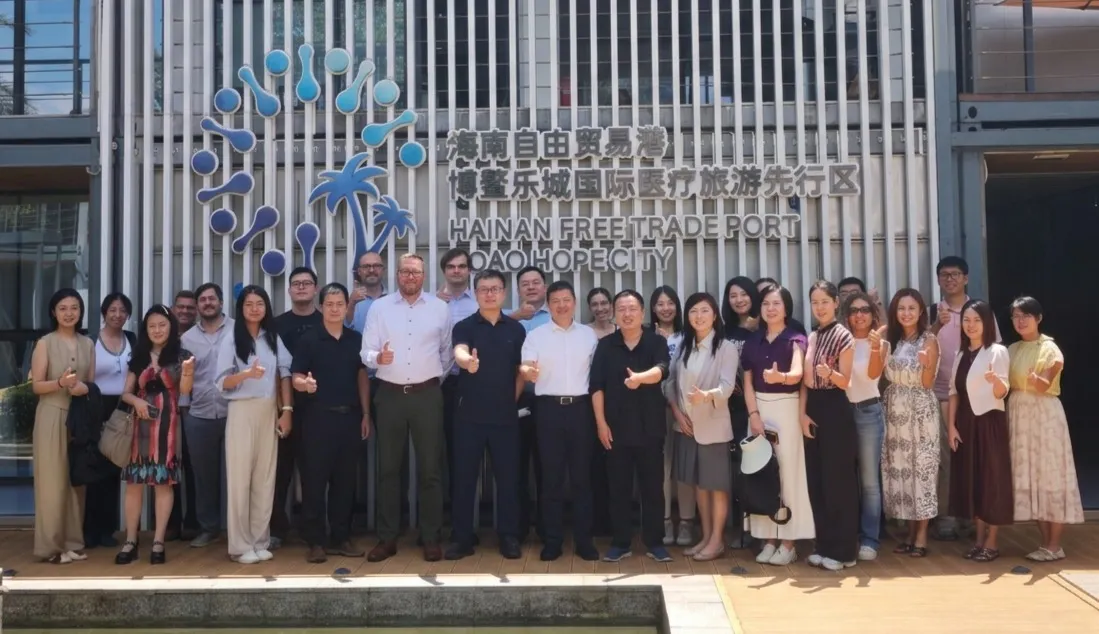
The final stop on our trip was the Boao Lecheng International Medical Tourism Pilot Zone, on the eastern coast of Hainan island. There we visited one of the two public hospitals approved for paid clinical use of biomedical products not yet approved elsewhere in China, the Boao branch of West China Hospital. The zone operates under a set of permissions that exist nowhere else in the country. A hospital there can import and administer a drug or device already approved by the FDA or EMA before the National Medical Products Administration (NMPA) has approved it, and Chinese or international patients can travel there to receive and pay for it.
China’s State Council created the zone in February 2013, with the goal of giving patients access to medicines and devices available abroad without leaving the country, and of building a world-class medical tourism destination by 2030. In English the zone is often promoted as “Boao Hope City,” and patients seeking treatments they cannot get elsewhere in China simply call it the “City of Hope” (希望之城). Beginning in 2018, Hainan was given authority to approve the import of urgently needed drugs and devices for use in the zone, and in 2019 the zone became a pilot for using the real-world data collected on those patients to support national registration. The first product approved by the NMPA using Lecheng real-world data, a glaucoma drainage device, was cleared in March 2020. By late 2025 the zone had brought in more than 500 innovative drugs and devices and served more than 180,000 patient visits. Until recently, nearly all of that activity was imported drugs and devices.
That changed in February 2025, when a new Hainan regulation took effect allowing the zone to approve biomedical new technologies, including cell and gene therapies. Lecheng now recognizes four routes into its review: a completed IIT that has demonstrated safety and efficacy, a Phase 2 or later trial approved by the NMPA, a Phase 2 or later trial approved by a regulator in another International Council for Harmonisation of Technical Requirements for Pharmaceuticals for Human Use member country, or marketing approval abroad.
818 with Boao Lecheng creates a route that did not exist before. A developer can run an IIT on the Chinese mainland under the new standards and, once safety and efficacy are demonstrated, seek approval to deliver and charge for the therapy in Boao Lecheng, where it is available to both Chinese and international patients, without the time and cost of a full registrational package. That Boao Lecheng accepts mainland IIT data as an entry route says something about the weight authorities now place on the post-818 standards. One estimate communicated to me during the visit with the administrators at Boao Lecheng was that a sponsor could spend roughly $3 to $5 million on development in China, generating safety and efficacy data in about 10 patients through an IIT, and then offer the therapy continuously in the zone.
My takeaway was that this pathway could significantly lower the barrier for patient groups to create treatment options for their own communities, particularly for ultra-rare diseases where the cost of reaching patients through a Biologics License Application (BLA) often doesn’t make sense. Compared with a full registrational program, a few million dollars is within reach of a well-organized patient foundation. It could also draw impact-driven entrepreneurs and investors to make ultra-rare gene therapies commercially viable, accelerating access for patients.
The economics, however, remain a challenge. China’s government currently reimburses no more than about $40,000 for a gene therapy, while pricing for international patients is uncapped. In the near term, international patients would likely need to cover a larger share of the cost for this model to be sustainable, and it’s unclear who would pay for it. Insurers outside China typically tie coverage to approval by their own regulators, and no one yet knows whether they’d pay for a therapy that never went through a BLA. Until that’s answered, the cost may fall on patients and their families. Over the longer term, technological advances that bring down the cost of goods sold could make that question matter less, putting these therapies within reach of China’s reimbursement system and of more families who would otherwise pay out of pocket.
It is still too early to know how this will work in practice, but it is encouraging that the option exists, and China isn’t alone in building it. Around the world, regulators and institutions are rethinking how therapies reach patients when the population is too small for a traditional trial. In the UK, the Rare Therapies Launch Pad, a consortium that includes Genomics England and the MHRA, is building an end-to-end route to individualized therapies for children with rare conditions. In the US, FDA leadership outlined a “plausible mechanism” pathway in November 2025 for bespoke therapies where traditional trials aren’t feasible. Groups are already organizing to use it. In July, the Broad Institute, Boston Children’s Hospital and the Jackson Laboratory launched the Center for Therapeutic Genetics, a nonprofit that builds gene-editing treatments for rare and ultra-rare diseases on a shared platform, so each new patient’s therapy can draw on the design tools, models and manufacturing of the ones before it. It plans to work alongside the FDA to generate the evidence these new frameworks need. Meaningful reform at a competitive scale will still require Congressional action, but the direction is clear. Patients with the rarest diseases are getting more than one place to turn.
Competition among regulators is driving much of this shift, and no single framework will be best for every program. Sean Russell, Managing Partner at PrimeRA Pharma Partners, whom I met at CSGCT, describes global development as a multidimensional chessboard. With the UK, EU, US and China all revising their frameworks at once, there’s no single correct opening sequence. The advantage goes to developers who understand every framework available to them, are clear on the goal for their product, and sequence their moves for the board as it stands today and as it’s likely to shift. That might mean one regulator or several. And every regulator rewriting its rules is trying to win those developers over. When regulators compete, patients and developers win.
Post-818 winners
Both gene therapy developers and patients stand to benefit. The post-818 rules substantially raise the quality bar for IITs, which reduces the risk for the patient and developer. In exchange, cost and time go up modestly, and the pathway still does useful work: it gives patients more options, provides an early clinical signal to inform IND study design, generates the data that attracts future investment, and lets a developer stop or pivot earlier so resources go where they will do the most good.
For developers who want IIT data to support a US filing, the FDA has signaled it will accept that data, as long as it can verify it. On September 2, the heads of the FDA’s drug, biologics, medical device and oncology centers wrote that the agency “actively welcomes and relies on” high-quality foreign data, and that it’s adding resources for foreign inspections and inspecting more Phase 1 and early-stage trials. It also expects sponsors to treat inspection access as “a material factor in their regulatory strategy, not an administrative footnote.” That investment is already showing up in China, where the FDA has added clinical site inspectors to its in-country staff.
A well-run IIT under Decree 818 already satisfies many of the FDA’s requirements. Before dosing the first patient, the NHC mandates toxicology, biodistribution, and large-animal safety data, alongside cGMP manufacturing, a package that closely mirrors an IND application. To successfully bridge this to an FDA submission, developers must ensure their toxicology studies are GLP-compliant and conduct the trial at a clinical site capable of FDA inspection (ideally one the agency has previously visited). To see how this works in practice, we visited CoJourney, a Hangzhou-based viral vector CDMO, which explained how sponsors can run an 818-compliant IIT while keeping the door open for an FDA filing. The key is dual-path planning from Day 1, including early engagement with the agency on data utilization.
The China IIT is no longer a dead end if executed well. If it succeeds, the developer has two ways forward: use the data to continue its development program outside China, or offer the therapy to patients through Boao Lecheng without ever pursuing a BLA.
Are IITs in China now safer for patients than we think?
In the months after September 11, 2001, Americans were understandably afraid to fly. In hindsight, it was arguably the safest time to be flying. In 2002 there were no deaths on US commercial airline flights, the first year in two decades without one. The government turned its attention to aviation safety: the Transportation Security Administration was created about two months after the attacks with broad new authority, security protocols became far stricter, and resources across the system were plentiful.
What happened in China is different in scale, but the response follows the same pattern. The three deaths in China that we know of should not have happened, and the system that allowed them has been overhauled. But psychologists have a name for what can follow a tragedy like this: dread risk, our tendency to overreact to rare, vivid catastrophes. This time, the cost of that overreaction would fall on patients, some of whom could be left with fewer options or none at all.
Following a nine-day itinerary across four cities, what I saw was a system that has reset the conditions for more responsible trials.
Anyone working to reach patients should understand this option well enough to weigh it thoughtfully against the others as they plan their moves. The cost of learning more about it is lower than you might think, and the potential to efficiently bring more therapies to patients sooner could more than make up for the effort.
And for global regulators working to reach developers, this is a moment where competing decisively, through meaningful reform, for the developers building these therapies and patients willing to travel for them, will keep both at home. China’s revised framework is now deployed. The UK is still building one, and the US has outlined one that Congress has yet to act on. The opportunity cost of standing still is high, both for patients and for local biotech ecosystems. The regulators who act now will shape where the next generation of these therapies are developed and who gets access to them first.
Register for FREE to comment or continue reading this article. Already registered? Login here.
1