
[Author Disclosure: This content reflects the views of the author and is provided for informational purposes only. It does not constitute investment advice and is not a recommendation or endorsement by BioTech Funding Portal. Any investment decision should be based solely on the issuer’s official offering materials.]
Reflections from a 2056 Club roundtable with members of the VNTR community
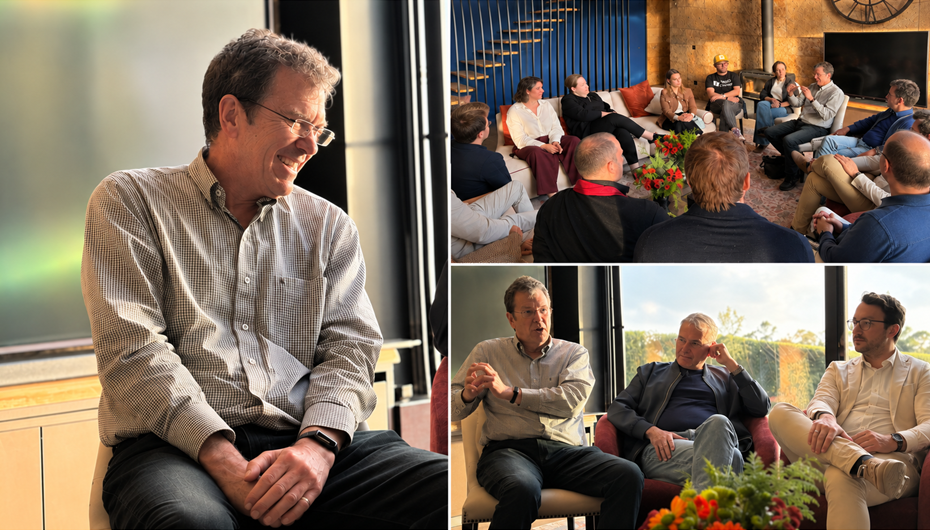
Last week, near Lisbon, I had the privilege of joining members of the 2056 Club, the private-member circle connected to the VNTR global investor community, for a roundtable on how families organize themselves to invest together.
My thanks to the 2056 Club and the VNTR community for the invitation, and especially to Olga Gedevskaya, who suggested both the topic and the conversation. She also set the format: not a presentation, but a conversation among equals. As she put it in opening, “what we gain is closely tied to what we give”. That proved true. I came to share our experience and left with a notebook full of other people's insights.
The club's name fits the subject. The "2056" looks thirty years ahead, a horizon measured in generations rather than quarters. That is exactly the horizon a family investment vehicle should be built for.
What follows is one family’s story, what I'd recommend to a family starting out, and some of the best ideas members contributed. One caveat up front: our structure is built around U.S. tax law. Members from Spain, Austria, the Middle East and elsewhere made clear that the right answer is local. Nothing here is legal or tax advice. Bring a good advisor before you bring your assets.
We Were a Family Office Before We Knew the Term
I spent my career in the C-suite of large life science companies such as Johnson & Johnson, Amgen and Moderna, leading communications and corporate affairs. I had grown up thinking I might become an investor or a trader. Life sciences pulled me in instead, because I believed in the missions of those companies. I kept investing along the way, the way some people keep up a serious hobby.
When I began investing on behalf of the wider family, I didn't call it a "family office." I was simply looking for a sensible way to invest with, and on behalf of, people I love. Only later did I realize what we had built. My guess is that many families are in the same place: already acting as a family office, informally, without a framework for doing it formally.
Why We Formed It
We set out five goals, and they still guide us:
- Stability for the generations ahead, an asset base that outlasts any one of us.
- Engaging the next generations in investing, so they learn by doing, not by inheriting.
- Supporting innovative industries and entrepreneurs, especially in breakthrough life sciences and information technology infrastructure.
- Tax consequences that are optimized, not an afterthought.
- Solid returns relative to risk.
There was also a quieter reason. My wife and I wanted to give our children a meaningful start on their estates while we're alive, rather than leaving everything to be sorted out after we're gone. And we wanted some distance between what our children might treat as ready cash and what they hold and build for the long term.
The Structure: Deliberately Simple
Our family vehicle, Elmstead Partners, is a single limited liability company. Multiple generations of our family own its assets. A few features do most of the work:
- Ownership follows contribution. Each member owns a set percentage based on their beginning assets. Growth or decline in value doesn't change that percentage. If you came in with 10%, you own 10% of whatever it becomes.
- Withdrawals reduce your share. Anyone can take money out, and the moment they do, their percentage goes down accordingly. Members can also add capital to increase their share.
- One roof. Public equities, private company positions and some family real estate and written loans all sit in the same entity. That keeps administration, reporting and accounting simple compared with a separate vehicle for each asset class.
- Pass-through taxation. The LLC pays no entity-level tax; income and gains flow through to the owners.
- A grantor-trust arrangement for the children's share. The children's interests are held so that, for income-tax purposes, I am treated as the owner (what the tax code rather unhelpfully calls a "intentionally defective" grantor trust). In practice, I pay the income tax on gains that build up in my children's share. That tax payment is not treated as a gift, so it becomes, in effect, an additional tax-free transfer to the next generation for as long as I'm alive.
Around the LLC sit a few secondary structures that keep the core simple rather than complicating it:
- 529 education accounts for grandchildren. Contributions are gifts, and growth is tax-free when used for qualified education. I manage the investing for most of these accounts, using the same thinking as the LLC; one family member preferred to manage their child's account themselves, and that's fine. It's decided account by account.
- GRATs (grantor retained annuity trusts) were established for a period of time for potential tax-efficient transfers to beneficiaries.
- A donor-advised fund for philanthropy, described below.
- A separate services company. We advise and support some portfolio companies through a separate operating entity, majority family-owned, with its own staff. Keeping that work out of the investment vehicle keeps both clean, and it means the potential conflicts between advising and investing are surfaced and managed rather than blurred.
Recommendation: start with the simplest structure that does the job. One entity, clear ownership rules, a written rule for withdrawals. Add complexity only when a specific tax or family need justifies it.
How It Was Funded, and How It Grew
When we formed the LLC, roughly fifteen years ago, its assets were mostly publicly traded equities. Our private portfolio was essentially built from the growth of that public portfolio, not from new contributions.
I didn't track our returns like a fund manager; we weren't a fund. Only when another family asked me how we'd done did I run the numbers. Over the ten years the brokerage analysis could measure, the public portfolio had produced a 19.2% annualized return. Over that period we were able to move the equivalent of more than 100% of the starting public portfolio into private investments, while the public portfolio itself continued to grow.
Stock selection mattered, but so did timing discipline. I use seasonality analysis: averaging ten or twenty years of a stock's daily movements into a single January-to-December pattern to find recurring windows to buy, hold, avoid or hedge. If a company looks attractive on fundamentals, it goes on a watch list, and I wait for a seasonally favorable entry point. If a stock stops behaving the way its history predicts, I leave it alone that year. One can even isolate patterns by phase of the U.S. election cycle; midterm years behave differently for certain sectors.
Today the private side holds positions in 72 early-stage life science companies, selected from some 450 to 500 I've personally reviewed, plus 45 to 50 positions outside life sciences.
A Barbell, and a Long Horizon
Because so much of our base sits in large public companies, we can afford to go very early on the private side, sometimes at the equivalent of a seed round. It's a barbell: established companies on one end, breakthrough-stage companies on the other.
The family structure makes this possible. We are not investing for a quick exit. We're investing for value creation over time. I often ask founders: "Do you want to exit in two years, or in two generations?" Either answer can work. But knowing the answer tells us whether we're truly aligned.
Five Pillars: Simple, Not Easy
I like to use five clear tests for virtually every private life science investment we make. Each one takes a sentence to state and years of judgment to answer:
- Potential breakthrough innovation. Is this a genuine discontinuity, or an incremental improvement dressed up as one? Healthcare is too slow and too hard to navigate to chase modest gains or better reimbursement for an existing approach.
- A clear first application. Can it be aimed at one definable, reachable use, with a real patient and payer at the end of it? I've heard too many pitches for "a platform that will treat cancer, then cardiovascular disease, then everything else." Pick the beachhead first.
- The potential to move beyond that first application. Once proven, does it travel? This is what earns platform status, and platform status is what earns the return. It's also where most otherwise excellent companies fall out: a single-application breakthrough is a product, not a platform.
- Intellectual property that protects the differentiation. Is the advantage defensible, and does the company own it?
- A team that can carry it from science to product.
For an early-stage company, the hypothesis has to be understandable. I want to see a few compelling charts. They don't have to be human data yet, but I often bring in a more-qualified individual to double-click on the assumptions behind them.
Our current largest position, ARC Medical, illustrates the pillars well. Its breakthrough is a liquid polymer that flows through an entire surgical site and forms a temporary barrier against surgical adhesions. Its first in-human clinical application is orthopedic surgery: knee, shoulder, hip. Beyond that, the same polymer extends into gynecologic and abdominal surgery. We've invested in it repeatedly over several years, and our conviction has grown each time.
The pillars have done something I didn't anticipate: they've become our family's shared vocabulary. A grandparent and a child can disagree about an opportunity using the same five tests.
Governance: Collaborative by Design
Here is the governance feature I find most interesting. I make the investment decisions, but I own only a minority of the entity. The decision I can't make is whether I keep the job. The owners determine the manager's authority, and they can replace me. That keeps me collaborative.
In practice, our process looks like this:
- Input, then a decision. We're a relatively large family, and extended family members contribute to decisions too. When an opportunity looks promising, I take it to those best placed to judge it: children, spouses, friends, anyone with relevant expertise. Participation is not a vote, and saying that plainly keeps the engagement genuine rather than ceremonial. I gather input, weigh it and decide.
- Use the expertise we already have. Before our first investment in ARC Medical, I didn't know what surgical adhesions were. A colleague of a family member who is a surgical oncologist at a leading academic hospital told me that a liquid solution to them would be "absolutely game-changing." Another family member, a computational biologist, can help review our data-driven opportunities. Most families have more expertise around the table than they realize.
- Let conviction show itself. Often one person has a much stronger insight than others. Just last week I consulted four family members on two separate opportunities. On one, the consistent response was "let’s go in, and go in big." On the other, two were unsure and two had concerns, so I didn't pursue it.
- Light, regular communication. We hold no standing management meetings. I reach out individually or to small groups when an opportunity arises, and every couple of months I may pull everyone together on a video call to review the portfolio, my thinking on market trends and/or to solicit what family members are seeing.
- Outside experts, opportunity by opportunity. We don't have a non-family advisory board. Instead, I draw on a network of experts, life science CEO networks, and a few venture funds that give us access to deals we couldn't otherwise reach.
A humbling note: so far, some of the best returns in our private portfolio have come not from my life science picks, which are a long game, but from investments the next generation pushed me toward in technology infrastructure and energy, including early positions in frontier AI companies. On my own, I probably would have looked at those through a value lens and passed. They saw something I didn't - and were correct!
Transparency and the Next Generation
On this topic, I'll admit we were a little cautious at first. Our advisors recommended, and I agreed, that we not disclose the full asset base to our children when they were young. We told them they had a share in what the family held, without the details. We also waited to create their interests until we were confident they were secure in their own careers and wouldn't become dependent on the fund.
Now that they're established, we share much more: values, trends, structure and reasoning.
The results have been encouraging. In more than ten years, none of our children has withdrawn any funds. We have written some loans and mortgages to them.
A member asked whether our children had become more financially responsible because of the approach. I have no control group to prove anything. But I learned finance on the street, with no family conversations about it growing up. My children are more aware of investment thinking and tax consequences than I was at their age, because they've been part of the decisions.
Bringing them in has meant real exposure, early: reading actual materials, meeting founders and sometimes joining expert calls on live opportunities rather than case studies.
Giving: Philanthropy Under the Same Roof, in a Separate Vehicle
We run our philanthropy through a separate donor-advised fund, using the same family members to allocate gifts, but not the same entity. Its most useful feature is the ability to donate appreciated stock that we haven't sold. Suppose a $10,000 investment is now worth $100,000. Donating the shares means no capital-gains tax on the $90,000 gain, and generally a deduction for the full $100,000 (subject to income limits). The fund stays invested, we grant from it every year, and the family helps decide where those grants go.
Tools We Use, and Tax Realities
A few practical tools have earned a place in our approach:
- Hedging instead of selling. A long-held, highly appreciated portfolio carries a large embedded tax bill. When seasonality says a stock is likely to dip, selling and buying back would trigger that tax. We use options strategies such as protective puts instead, while staying mindful of the tax rules that govern hedges on appreciated positions.
- Debt with warrants for follow-on support. When we've reached our equity risk appetite in a private company but it needs bridge capital, we've sometimes provided a short-term loan at the IRS-required minimum interest rate, paired with warrants. That gives the company runway and keeps us exposed to the upside without adding more straight equity.
- SPVs to bring others in. For a few of our highest-conviction companies, we've begun forming special purpose vehicles under a U.S. exemption (Rule 506(c)) that permits broad outreach to accredited investors, with verification handled by the platform. It's a way to help companies we believe in raise capital from others, not only from us. Sometimes CEO’s ask me to join investor pitches as a "high-conviction" investor. When it's one of your large investments, you want to be in that room.
Something I learned from the discussion is that strategy has to follow local tax drivers. The roundtable made that vivid. Nearly every tool I’ve described here (the pass-through LLC, the grantor trust, 529 accounts, donor-advised funds) is a creature of the U.S. tax code, and members from Europe made clear that the equivalents there are national rather than EU-wide, and often look quite different. The lesson I took away: borrow the principles freely, but let a good local advisor design the structure.
Voices From the Room
The richest part of the afternoon was hearing how other members approach the same questions. With gratitude for their candor, a few insights stood out:
- Accountability through outside capital. One member structured his vehicle as a formal fund, with his own capital alongside outside LPs. Being measured on distributions and multiples like any fund, he said, "keeps me honest." His children are young adults; one wants to join him, and he has asked her to get educated and experience life first. He also observed that what we're doing informally isn't far from running a fund.
- From enthusiasm to discipline. Another member inherited a portfolio of early-stage direct investments chosen because "this founder pitched well and we liked him." The hit rate was poor; as he put it, everything sounds great in due diligence. He shifted most of the allocation to best-in-class managers, kept a smaller special-situations portfolio he still runs directly, and opened that portfolio to outside investors. Doing so forced an institutional approach, where everything is documented.
- Regulated structures as a family peace-keeper. A member from Spain explained that many Spanish family fortunes still sit inside the operating company. Some families pool investments in a regulated venture vehicle (an SCR) with a professional manager supervised by the regulator. Such vehicles offer meaningful tax efficiency in exchange for limits, such as no listed stocks or real estate. In one case two brothers who had fallen out could still invest together, because the professional structure stood between them. The largest families often add a foundation for philanthropy. Another member described spending two years restructuring holdings across European jurisdictions to get the tax treatment right.
- Building your own analytical edge. One group of friends built their own AI-based platform for fundamental and sector analysis of public equities, so that a non-professional member could invest with professional discipline.
The common thread: every successful approach in the room found a way to aggregate informed input, whether from friends, outside LPs, professional managers or family members. Unchecked, the old adage holds: the first generation builds the wealth, the second uses it, the third loses it. Structured input is how families break that pattern.
Recommendations for Families Starting Out
- Name your purpose first. Be clear on why the vehicle exists. Our generational goals settle more debates than any rule.
- Choose the simplest structure that works, ideally one entity with clear rules on ownership, contributions and withdrawals. Get local tax and legal advice before you fund it.
- Make the manager accountable to the owners. Being removable is healthy.
- Separate input from decision-making. Invite broad participation and expertise; keep decisions clear and fast.
- Adopt a shared investment language. Our five pillars are short enough for anyone in the family to use.
- Fund the long horizon from a stable base. Let a durable core portfolio fund patient, early-stage bets.
- Pace transparency to maturity. Share more as the next generation becomes independent, and then share fully.
- Bring the next generation into real decisions, and expect to learn from them.
- Keep philanthropy and operating activities in separate vehicles, run by the same family values.
- Measure yourself honestly. Even if you're not a fund, know your returns. Someone will eventually ask.
The Takeaway
An informal family office doesn't need a large staff, a glossy governance manual or a nine-figure balance sheet. It needs a clear purpose, a simple structure, a disciplined investment language and a family willing to engage. Simple, but not easy.
I'm grateful to the 2056 Club and the VNTR community for creating a space where these conversations happen openly, and to the members who shared their experiences so generously. I'm grateful, too, to my own family, for the trust that makes our arrangement work and for the ideas that keep making it better.
If you're building or rethinking a family investment vehicle, or you'd like to compare notes on early-stage life science investing, I'd welcome the conversation.
This article reflects personal experience and is not legal, tax or investment advice. Tax treatment depends on your jurisdiction and circumstances; consult qualified advisors.
Register for FREE to comment or continue reading this article. Already registered? Login here.
2