

[Author Disclosure: This content reflects the views of the author and is provided for informational purposes only. It does not constitute investment advice and is not a recommendation or endorsement by BioTech Funding Portal. Any investment decision should be based solely on the issuer’s official offering materials.]
We asked 51 people living with Fabry disease a single question: if a new treatment could improve just one symptom, which would matter most to your quality of life?
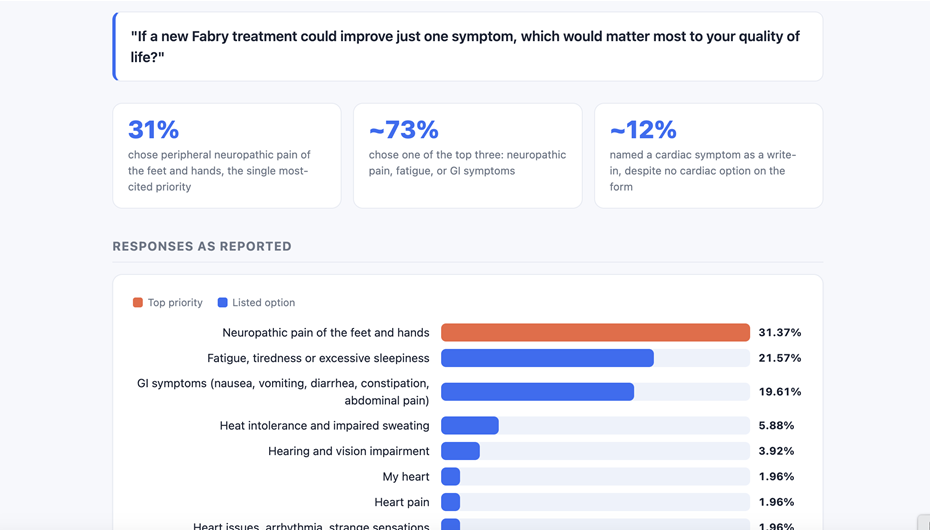
A snap shot of the results are in the figure and they matter to how we think about where a new therapy creates value.
Neuropathic pain of the feet and hands came first at 31%, followed by fatigue at 22% and gastrointestinal symptoms at 20%. Together, those three account for roughly three out of four respondents. A further 12% wrote in a cardiac symptom on their own, even though the form offered no cardiac option, which tells us cardiac concern is under-counted here rather than absent.
Why this is worth sharing: the symptoms patients rank highest are the same ones the current standard of care addresses least completely.
Enzyme replacement therapy (ERT) has been the standard in Fabry for two decades and was a genuine advance over no disease-specific treatment. But an infused enzyme clears from the blood within hours, distributes unevenly across tissues, and reaches some compartments far better than others. Patients experience this as a peak and trough cycle: steadier after an infusion, then symptomatic again before the next one. The burdens that persist are not random. They concentrate in exactly the domains patients told us they care about most.
This is the gap Glafabra is building toward. Our Live-cel platform uses the patient's own engineered cells as a continuous, internal source of the missing enzyme, secreting it steadily so neighboring cells can take it up, a mechanism called cross-correction. Peripheral neuropathic pain, the leading concern in this survey, arises from small-fiber and dorsal-root-ganglion involvement, a peripheral target that cross-correction can reach. The aim is not a better infusion. It is removing the infusion cycle that produces the trough in the first place.
A word on what this survey is and is not. It is a self-selected community sample of 51 respondents, single-select, and a prioritization exercise rather than a clinical outcome measure. It does not measure how well any therapy works, including ours. What it does do is ground our development priorities in lived patient experience, and it aligns closely with the documented limitations of current care.
Glafabra is pre-IND. Our lead program, GT-GLA-S03, is supported by a five-year investigator-initiated proof-of-concept study conducted by our co-founders under Canadian regulatory oversight, and the work ahead is to carry that into a US trial. When patients rank their own burden, we think the field should build toward the top of that list.
------------------------------------
Glafabra is considering a capital raise and we are "Testing the Waters" under Regulation Crowdfunding. No money or other consideration is being solicited, and any sent in response will not be accepted. We cannot accept any offer to buy securities, and no part of the purchase price can be received, until an offering statement is filed and only through the BioTech Funding Portal platform for the regCF raise. Any indication of interest is non-binding and involves no obligation or commitment of any kind.
Register for FREE to comment or continue reading this article. Already registered? Login here.
0