
[Author Disclosure: This content reflects the views of the author and is provided for informational purposes only. It does not constitute investment advice and is not a recommendation or endorsement by BioTech Funding Portal. Any investment decision should be based solely on the issuer’s official offering materials.]
From laboratory discoveries to clinical trials, the path to developing new treatments is filled with scientific and technical challenges. Understanding those challenges helps explain why even the most promising research doesn't always lead to a new medicine.
It seems like every week we hear about a new scientific breakthrough that could completely change how we treat a devastating disease. For patients and families waiting for better treatments, these discoveries offer tremendous hope.
But then years pass, and the promised treatment never arrives.
Why does so much promising science fail to become a viable treatment?
As a neuroscientist who has spent much of my career in scientific research and the pharmaceutical industry, I know that making a scientific discovery is only the beginning. Turning that discovery into a safe and effective treatment for patients is an entirely different challenge.
And the obstacles are not always what people expect.
Why Do Promising Drugs Fail in Humans?
One of the greatest challenges in medical research is that the biology of human disease is extraordinarily complex.
Scientists often begin by studying a disease in laboratory-grown cells or animal models. These experiments help researchers understand what may be causing a disease and whether a new treatment might work.
But an animal model can never fully reproduce what happens in a human patient.
Differences in genetics, metabolism, immune responses, and disease progression can dramatically affect how a treatment works. Even when scientists create an animal model that reproduces certain features of a human disease, it may not capture the full complexity of that disease.
Consider neurological conditions such as Alzheimer's disease. A treatment might improve certain measures of disease in laboratory animals but fail to produce meaningful improvements in memory or cognition when tested in people.
A 2024 analysis published in PLOS Biology examined 122 research reviews covering 54 human diseases. The researchers found that only about 5% of the animal-tested therapeutic interventions studied ultimately reached regulatory approval. Interestingly, they also found substantial agreement between animal and human study results when comparable findings were available. The research illustrates both the value of animal studies and the difficulty of translating promising findings into approved treatments. [1]
A treatment also needs to reach the right cells or tissues, remain active long enough to have an effect, and avoid causing unacceptable side effects.
This is why promising laboratory results, while exciting, are not proof that a treatment will work in humans.
Why Does Developing a New Treatment Take So Long?
Before a new drug can reach patients, researchers must answer a series of increasingly difficult questions.
Does it appear to work? Is it safe? What dose should be used? Does it provide a meaningful benefit to patients? Do the benefits outweigh the risks?
Each question requires carefully designed studies and evidence.
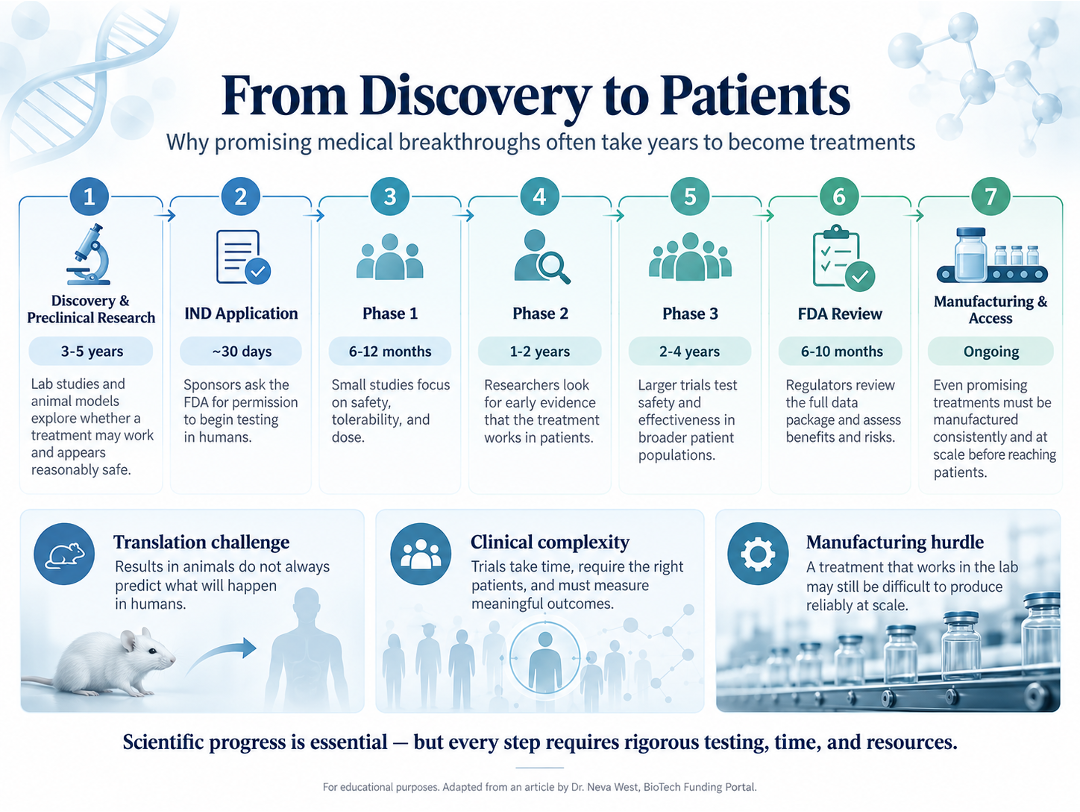
The U.S. Food and Drug Administration (FDA) describes a development process that moves from laboratory discovery and preclinical research into human clinical trials and regulatory review. [2]
For many new drugs, clinical testing typically involves three major phases:
- Phase 1: Researchers focus primarily on safety, how the drug behaves in the body, and appropriate dosing.
- Phase 2: Studies in patients look for preliminary evidence that the treatment works, while continuing to evaluate safety.
- Phase 3: Larger studies provide additional evidence about effectiveness and safety, helping regulators assess the treatment's overall benefits and risks.
These phases may overlap, and development programs can differ depending on the disease and type of treatment.
Clinical trials are also more complicated than simply giving patients a drug and observing what happens.
Researchers must determine how to measure whether a treatment is working. A change in a laboratory measurement may be encouraging, but does it translate into something meaningful for patients, such as improved mobility, reduced pain, or slower disease progression?
Finding the right patients can be another major challenge, especially for rare diseases. Patients may be geographically dispersed, difficult to diagnose, or unable to travel to specialized trial centers. Researchers may also need to follow patients for extended periods to understand the treatment's effects.
These challenges help explain why medical development takes years and why treatments that show early promise may not succeed in later studies.
Importantly, a clinical trial that does not demonstrate the hoped-for benefit is not necessarily wasted research. Negative results can improve our understanding of disease and help scientists develop better approaches.
What If a Treatment Works but Cannot Be Manufactured?
Even successful clinical research does not guarantee that a treatment will become commercially available.
A drug that can be produced in small quantities in a research laboratory may be difficult to manufacture consistently in the larger quantities needed to serve patients.
Manufacturers must demonstrate that each batch meets strict quality standards and that the treatment remains stable and maintains its intended quality throughout its shelf life.
This can be particularly challenging for complex biological treatments, including some cell and gene therapies, where the manufacturing process itself can significantly affect the final product.
The FDA's 2026 guidance addressing manufacturing and quality requirements for cell and gene therapies reflects the specialized considerations involved in developing these treatments. [3]
A treatment may be scientifically promising and demonstrate clinical benefit, yet still encounter obstacles because it cannot be manufactured reliably or at a commercially sustainable cost.
In other words, proving that a treatment works is not always enough. Scientists and developers must also figure out how to deliver it consistently and safely to the patients who need it.
When the Science Is Promising, What Else Stands in the Way?
Not every scientific discovery will become a successful treatment. Careful research helps determine which approaches are safe, effective, and worthy of further development.
But sometimes promising research stalls for reasons unrelated to whether the underlying scientific idea has merit.
Developing new treatments requires funding at every stage, from laboratory experiments to clinical trials and manufacturing. Early academic research may be supported by government or foundation grants, while larger investors and pharmaceutical companies often seek more advanced evidence before committing substantial capital.
That can leave young biotech companies struggling to fund the very studies needed to demonstrate their potential.
At BioTech Funding Portal, we believe regulated investment crowdfunding can provide one additional financing pathway for early-stage life science companies seeking to advance their research.
Crowdfunding cannot eliminate scientific uncertainty, and investing in early-stage biotech companies carries significant financial risks. But expanding access to capital may help some companies generate the evidence needed to determine whether their discoveries can progress toward clinical development.
Bringing More People Into the Scientific Conversation
One of the things that excites me most about biomedical innovation is that the discoveries being made today could affect any of us tomorrow.
Patients and caregivers often have a deeply personal understanding of the challenges associated with a disease. Scientists bring expertise in the underlying biology. Clinicians understand how diseases affect patients in practice. Entrepreneurs work to translate discoveries into treatments.
Each perspective matters.
I believe we have an opportunity to bring these communities closer together, creating more informed conversations about emerging science, unmet medical needs, and the challenges involved in developing better treatments.
That is an important part of our mission at BioTech Funding Portal: connecting life science innovators with a broader community of people interested in understanding and supporting scientific progress.
Not every promising discovery will become a successful treatment. Scientific uncertainty is unavoidable, and rigorous testing is essential to protecting patients.
But we can work to ensure that promising science receives the attention, evaluation, and opportunities it deserves.
Because the ultimate goal of biomedical research isn't simply to make discoveries. It's to turn those discoveries into treatments that improve people's lives.
Scientific References
[1] Animal-to-Human Translation
Ineichen BV, Furrer E, Grüninger SL, Zürrer WE, Macleod MR. (2024). Analysis of animal-to-human translation shows that only 5% of animal-tested therapeutic interventions obtain regulatory approval for human applications.PLOS Biology, 22(6), e3002667.
https://b2f.bz/dFnxn
[2] The Drug Development Process
U.S. Food and Drug Administration (FDA). The Drug Development Process. Overview of drug discovery, preclinical research, clinical testing, regulatory review, and post-market monitoring.
https://b2f.bz/mKZCd
[3] Manufacturing Challenges for Advanced Therapies
U.S. Food and Drug Administration (FDA). (May 2026). Chemistry, Manufacturing, and Controls Flexibilities for Developing Human Cellular and Gene Therapy Products for a Biologics License Application. Guidance for Industry.
https://b2f.bz/VkF8b
Author Disclosure: This article is published by BioTech Funding Portal LLC for educational and informational purposes only. It does not constitute investment advice or a recommendation or endorsement of any securities offering. Investments in early-stage life science companies are speculative, illiquid, and involve significant risks, including the potential loss of the entire investment. Investors should conduct their own due diligence and review the applicable offering materials and risk disclosures before making an investment decision.
Register for FREE to comment or continue reading this article. Already registered? Login here.
1