
[Author Disclosure: This content reflects the views of the author and is provided for informational purposes only. It does not constitute investment advice and is not a recommendation or endorsement by BioTech Funding Portal. Any investment decision should be based solely on the issuer’s official offering materials.]
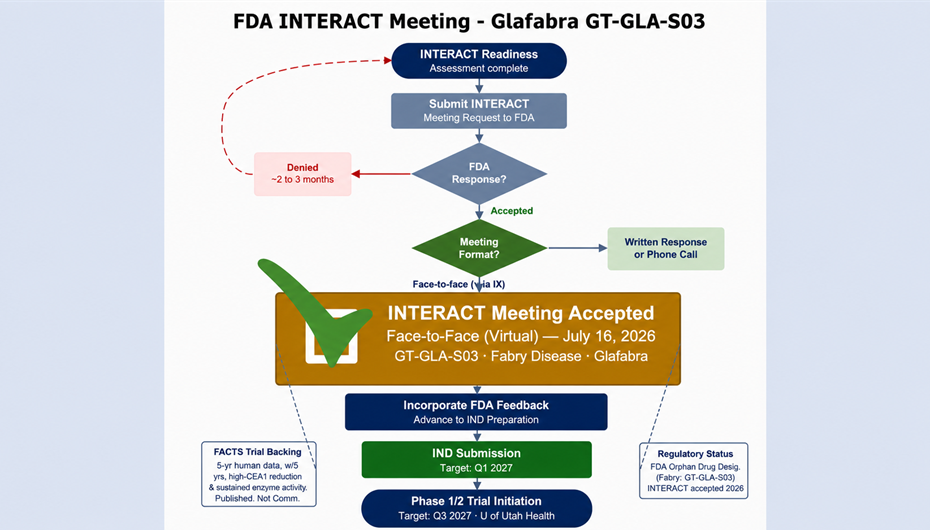
Glafabra granted a face-to-face INTERACT meeting slated to occur July 16, 2026.
We will be discussing with the FDA key questions that will set the development path of our GT-GLA-S03 cell-based gene therapy for Fabry in its journey towards the market.
This milestone achievement was only made possible with the amazing contributions of the internal team and our contractors. Many thanks to Elizabeth Wagner, Dwayne Barber, Lara Ionescu Silverman Tetsu Yung PhD MBA, Sidney Norton, Kevin Marhenke, Pharm.D., Isaac Collette, Krista Casazza Jeff Medin, Ronan Foley, Aneal Khan, Michael West, Armand Keating, Chuck Bucklar, Marshall Summar, M.D., Alan Freeman
The steps are many and challenging as Glafabra journeys to bring a therapy to the Fabry patients who need it at The National Fabry Disease Foundation, Fabry Support & Information Group, Canadian Fabry Association, Fabry International Network and more.
Glafabra deeply appreciates your support and helping us shape a new therapy that can bring meaningful change to the lives of patients living with Fabry disease.
INTERACT Meeting Accepted and Scheduled
FOR IMMEDIATE RELEASE
May 9, 2026
Glafabra Therapeutics Receives FDA Acceptance for Face-to-Face INTERACT Meeting for GT-GLA-S03, Its Cell-Based Gene Therapy for Fabry Disease
Face-to-face acceptance, granted to fewer than one in three INTERACT applicants and initiates formal FDA pre-IND dialogue to advances IND filing in Q1 2027
SALT LAKE CITY, Utah, May 10, 2026 -- Glafabra Therapeutics today announced that the U.S. Food and Drug Administration (FDA) has accepted the company's INTERACT meeting request for GT-GLA-S03, its autologous lentivirus-mediated cell-based gene therapy for Fabry disease, as a face-to-face virtual meeting scheduled for July 16, 2026.
About the INTERACT Meeting and Its Significance
The FDA's Investigational New Drug preparatory (INTERACT) meeting program allows cell and gene therapy developers to obtain direct agency feedback on clinical, manufacturing, and regulatory strategy before formal IND submission. Average acceptance rate for INTERACT meeting requests is approximately 30% for both written response and face-to-face meetings. The FDA denies approximately two-thirds of all INTERACT meeting requests (BGTC Playbook, 2025). When an INTERACT meeting is accepted, the face-to-face format is the highest-engagement response available, and is distinguished from written responses, due to the depth of real-time scientific dialogue it enables. The acceptance of Glafabra's INTERACT request as a face-to-face meeting places GT-GLA-S03 among a select group of early-stage programs granted this level of direct FDA engagement. Glafabra expects the feedback received at the July 16 meeting will directly inform the design of Glafabra's IND submission, targeted for Q1 2027, and will materially reduce regulatory uncertainty ahead of a planned Phase 1/2 trial initiation.
About GT-GLA-S03 and the Live-cel Platform
GT-GLA-S03 is the lead asset of Glafabra's Live-cel platform. It is a cell-based gene therapy made a lentivirus-modified autologous cells harvested from the patient. The therapy uses each patient's own cells that have been genetically modified to produce the enzyme missing in Fabry disease. The modified cells are reintroduced back into the patient, where they engraft in the bone marrow and start to make white blood cell progeny. The modified white blood cells go everywhere in the body and start to secrete the missing enzyme. Then in a process call Cross Correction, the neighboring cells can actively take up the secreted enzyme and use it to stop the build up of toxic lipid metabolites.
Conventional enzyme replacement therapy (ERT) requires 26 biweekly intravenous infusions per year for life. GT-GLA-S03 is designed to provide at least five years of durable therapeutic benefit from a single outpatient procedure. 130 clinical visits for infusions turned into one infusion visit every 5 years. Patients will no longer need to structure their life around their treatment schedule.
Five-Year Co-Founder Clinical Pilot Study Data
GT-GLA-S03's regulatory and clinical case is supported by five-year human data from the FACTS trial (NCT02800070), an investigator-initiated clinical pilot study led by Glafabra co-founders Dr. Jeffrey Medin and Dr. Ronan Foley and performed in Canada. Five patients were followed for five years with zero product-attributable serious adverse events.A critical biomarker endpoint demonstrated a 48% reduction in plasma lyso-Gb3 from the no-ERT baseline (p<0.0001, 99% statistical power). Four of five patients maintained lyso-Gb3 below the clinically elevated threshold at five-year follow-up, and four of five patients received the conditioning regimen as an outpatient procedure with same-day discharge. Trial results have been published in Nature Communications and Clinical and Translational Medicine. GT-GLA-S03 holds FDA Orphan Drug Designation for Fabry disease.
Differentiation from Existing and Emerging Therapies
GT-GLA-S03 is designed to serve the full Fabry patient population regardless of GLA variant, wherease chaperone based therapies can only treat 40% of the patient population. With enzyme replacement therapy (ERT) as standard of care approximately 30% of ERT-treated patients develop therapy neutralizing anti-drug antibodies (ADAs). After start of treatment with GT-GLA-S03, all patients who had been on ERT showed diminished antibody response over time.
With GT-GLA-S03 treatment, therapeutic enzyme levels were also diminished over time after cell therapy administration, indicating patients may benefit from repeat dosing after 5 years of treatment. Although one GT-GLA-S03 treatment does not yield lifetime durability, the use of non-myeloablative outpatient conditioning with low dose melphalan is more efficient to administer in a clinical setting and much easer for patients to take, when compared to severe busulfan-based myeloablative approaches.
Unlike AAV-based gene therapies, GT-GLA-S03 carries no pre-existing antibody barrier: anti-capsid antibodies present in approximately one-third of the general population prevent thier AAV treatment. However pre-existing anti capsid antibody titer does not prevent a patients treatment eligibility for GT-GLA-S03 therapy. While AAV-based therapies are advancing toward potential approval for Fabry disease, GT-GLA-S03 is also positioned as the only repeatable, variant-agnostic, antibody-status-agnostic treatment alternative for patients. This phenomenon may eventually even be useful rescue therapy for patients who completed an AAV Fabry trial and subsequently lost gene expression of the needed enzyme.
Beyond Fabry disease, the Live-cel platform is being developed for Gaucher and Pompe disease. Furthermore, there is the potential for Live-cel platform to address many of the approximately 70 lysosomal storage disorders and, more broadly, many of the estimated 900 known enzyme deficiency disorders.
Platform Breadth Across Lysosomal Storage Disorders
The Live-cel manufacturing process is applicable across multiple lysosomal enzyme deficiency disorders. Glafabra's pipeline includes GT-GAA-S04 for Pompe disease and GT-GBA1-S05 for Gaucher disease, both at preclinical stage with Orphan Drug Designation eligibility. Pompe and Gaucher programs also qualify for Rare Pediatric Disease Designation, creating potential Priority Review Voucher value of up to $200 million based on established precedent from programs including Nexviazyme (2021) and Pombiliti (2023).
"FDA's acceptance of INTERACT meeting request helps validate the clinical and manufacturing case we have been building for GT-GLA-S03," says CEO, Chris Hopkins. "With five years of published human data behind it, our reduced conditioning approach opens the door on bringing repeatable Live-cel therapy to the Fabry patients and beyond"
About Glafabra Therapeutics
Glafabra Therapeutics is a pre-clinical stage cell and gene therapy company developing the Live-cel platform for lysosomal storage disorders. The company's lead program, GT-GLA-S03 for Fabry disease, is supported by five-year co-founder clinical pilot study data published in peer-reviewed journals, FDA Orphan Drug Designation, and an FDA-accepted face-to-face INTERACT meeting on July 16, 2026. Glafabra is advancing an IND filing targeted for Q1 2027 and first patient enrollment targeted for Q3 2027 at the University of Utah Health.
Register for FREE to comment or continue reading this article. Already registered? Login here.
3