
[Author Disclosure: This content reflects the views of the author and is provided for informational purposes only. It does not constitute investment advice and is not a recommendation or endorsement by BioTech Funding Portal. Any investment decision should be based solely on the issuer’s official offering materials.]
Beyond Activation: Why Building Brown Fat May Succeed Where Waking It Up Failed
In the late 1980s and throughout the 1990s, several large pharmaceutical companies tried to develop obesity drugs that would acutely activate thermogenesis - the body’s process of dissipating energy as heat. The idea was to increase resting metabolic rate and turn stored fat into heat by stimulating the activity of brown fat (thermogenic fat).
This effort grew out of the discovery of the β3-adrenergic receptor (β3-AR) [1, 2]. In rodents, compounds that activated this receptor increased thermogenesis in brown fat and caused substantial weight loss, largely by reducing body fat and without reducing food intake. These findings led companies to develop drugs designed to selectively activate the human version of β3-AR, with the hope of reproducing those results in patients.
But these programs were much less successful in humans than in rodents, for both safety and efficacy reasons.
On the safety side, compounds aimed at the human β3-AR were not fully selective. At doses high enough to work, they also activated related receptors, β1-AR and β2-AR, which caused side effects including increased heart rate, higher blood pressure, and tremor [3, 4, 5].
On the efficacy side, the effects seen in rodents did not translate well to humans. This is partly because human brown fat cells contain much less β3-AR than rodent brown fat cells, and also because human brown fat relies less on β3-AR signaling overall [4, 5, 6, 7, 8].
There is also an important biological difference between rodents and humans. Rodents housed at normal laboratory temperatures are actually cold relative to their preferred temperature, so they maintain a large amount of brown fat to generate heat. Humans at room temperature do not have the same need, so they maintain much less brown fat. Moreover, obese humans have even less brown fat than lean individuals [3, 9, 10, 11, 12, 13]. As a result, simply stimulating the existing brown fat in humans did not produce the large energy expenditure seen in rodents.
These findings led to two key conclusions:
- β3-AR is not a suitable obesity target in humans.
- To achieve meaningful anti-obesity effects in humans, it is necessary to increase brown fat mass – that is, the number of thermogenic fat cells – rather than merely activate the limited number already present.
That insight was important, but it was not enough on its own. Researchers still needed a way to reliably increase human brown fat.
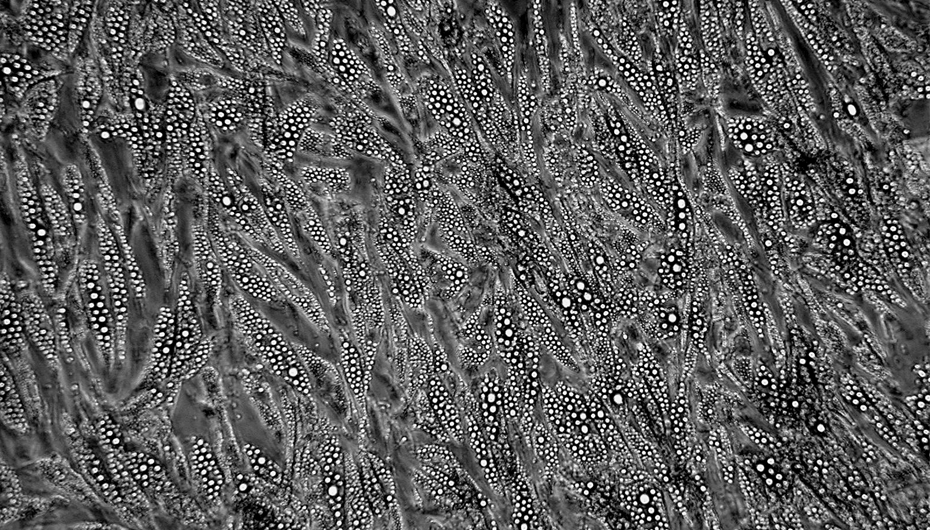
A major step forward came with the discovery of the first human brown fat adult stem, or progenitor, cells [14]. Energesis’ founders used these cells to build a screening platform for finding drug targets and compounds that can drive these progenitor cells to become new, active brown fat cells [3]. These new thermogenic fat cells consume large amounts of glucose and fatty acids, and in animal models of obesity produce highly significant weight loss, all of which is from fat.
Energesis has therefore taken a different approach from earlier brown fat programs. Instead of trying to wake up the limited brown fat already present, the goal is to create more of it by targeting brown fat stem/progenitor cells. Our research focus now is to advance the most promising drug candidates into testing in higher species, including humans, with the aim of developing safe new treatments for obesity that increase energy expenditure through brown fat.
Sources
- Emorine LJ, Marullo S, Briend-Sutren MM, Patey G, Tate K, Delavier-Klutchko C, Strosberg AD. Molecular characterization of the human beta 3-adrenergic receptor. Science. 1989 Sep 8;245(4922):1118-21. doi: 10.1126/science.2570461.
- Muzzin P, Revelli JP, Kuhne F, Gocayne JD, McCombie WR, Venter JC, Giacobino JP, Fraser CM. An adipose tissue-specific beta-adrenergic receptor. Molecular cloning and down-regulation in obesity. J Biol Chem. 1991 Dec 15;266(35):24053-8.
- Boss O, and Farmer SR. Recruitment of brown adipose tissue as a therapy for obesity-associated diseases. Front Endocrinol (Lausanne) 3: 14, 2012.
- Arch JR. The discovery of drugs for obesity, the metabolic effects of leptin and variable receptor pharmacology: perspectives from beta3-adrenoceptor agonists. Naunyn Schmiedebergs Arch Pharmacol. 2008 Aug;378(2):225-40. doi: 10.1007/s00210-008-0271-1.
- Clapham JC, Arch JR. Targeting thermogenesis and related pathways in anti-obesity drug discovery. Pharmacol Ther. 2011 Sep;131(3):295-308. doi: 10.1016/j.pharmthera.2011.04.004.
- Deng C, Paoloni-Giacobino A, Kuehne F, Boss O, Revelli JP, Moinat M, Cawthorne MA, Muzzin P, Giacobino JP. Respective degree of expression of beta 1-, beta 2- and beta 3-adrenoceptors in human brown and white adipose tissues. Br J Pharmacol. 1996 Jun;118(4):929-34.
- Arch JR. Challenges in β(3)-Adrenoceptor Agonist Drug Development. Ther Adv Endocrinol Metab. 2011 Apr;2(2):59-64. doi: 10.1177/2042018811398517. PMID: 23148171; PMCID: PMC3474627.
- Blondin DP, Nielsen S, Kuipers EN, Severinsen MC, Jensen VH, Miard S, Jespersen NZ, Kooijman S, Boon MR, Fortin M, Phoenix S, Frisch F, Guérin B, Turcotte ÉE, Haman F, Richard D, Picard F, Rensen PCN, Scheele C, Carpentier AC. Human Brown Adipocyte Thermogenesis Is Driven by β2-AR Stimulation. Cell Metab. 2020 Aug 4;32(2):287-300.e7. doi: 10.1016/j.cmet.2020.07.005. PMID: 32755608.
- Saito M, Okamatsu-Ogura Y, Matsushita M, Watanabe K, Yoneshiro T, Nio-Kobayashi J, Iwanaga T, Miyagawa M, Kameya T, Nakada K, Kawai Y, Tsujisaki M. High incidence of metabolically active brown adipose tissue in healthy adult humans: effects of cold exposure and adiposity. Diabetes. 2009 Jul;58(7):1526-31. doi: 10.2337/db09-0530.
- Becher T, Palanisamy S, Kramer DJ, Eljalby M, Marx SJ, Wibmer AG, Butler SD, Jiang CS, Vaughan R, Schöder H, Mark A, Cohen P. Brown adipose tissue is associated with cardiometabolic health. Nat Med. 2021 Jan;27(1):58-65. doi: 10.1038/s41591-020-1126-7.
- van Marken Lichtenbelt WD, Vanhommerig JW, Smulders NM, Drossaerts JM, Kemerink GJ, Bouvy ND, Schrauwen P, Teule GJ. Cold-activated brown adipose tissue in healthy men. N Engl J Med. 2009 Apr 9;360(15):1500-8.
- Cypess AM, Lehman S, Williams G, Tal I, Rodman D, Goldfine AB, Kuo FC, Palmer EL, Tseng YH, Doria A, Kolodny GM, Kahn CR. Identification and importance of brown adipose tissue in adult humans. N Engl J Med. 2009 Apr 9;360(15):1509-17. PubMed PMID: 19357406.
- Virtanen KA, Lidell ME, Orava J, Heglind M, Westergren R, Niemi T, Taittonen M, Laine J, Savisto NJ, Enerbäck S, Nuutila P. Functional brown adipose tissue in healthy adults. N Engl J Med. 2009 Apr 9;360(15):1518-25. PubMed PMID: 19357407.
- Crisan M, Casteilla L, Lehr L, Carmona M, Paoloni-Giacobino A, Yap S, Sun B, Leger B, Logar A, Penicaud L, Schrauwen P, Cameron-Smith D, Russell AP, Peault B, Giacobino JP. A reservoir of brown adipocyte progenitors in human skeletal muscle. Stem Cells. 2008 Sep;26(9):2425-33.
Register for FREE to comment or continue reading this article. Already registered? Login here.
0