Content reflects the views of the posting party and is provided for informational purposes only. It does not constitute a solicitation, recommendation, endorsement, or investment advice by BioTech Funding Portal. All content is subject to the portal’s Community Content Guidelines.

Two Months Into Testing the Waters: What's Ahead for Glafabra
 Glafabra
Two months of Testing the Waters, almost to the day.
Since June 22: 18 questions answered through DECODE, four members of the Glafabra team introduced in person on LinkedIn, and a real-time record of an FDA meeting, a protocol taking shape, and a Japan strategy moving in parallel with the U.S. one.
What's ahead: more team introductions, continued DECODE questions, and whatever comes out of IFFD an...more

How Common Is Fabry Disease? — DECODE No. 18
(Answer to the question last time on August 31: hands and feet — acroparesthesia, caused by small-fiber nerve involvement, often starting in childhood.)
Fabry disease is rare, but estimates for exactly how rare span a wide range — and most researchers think the real number is higher than any of them.
Roughly how many people are estimated to be born with Fabry disease? Drop your guess in the commen...more
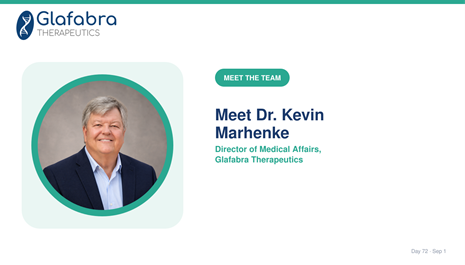
Meet Glafabra's Director of Medical Affairs, Dr. Kevin Marhenke
Meet Dr. Kevin Marhenke, PharmD, Director of Medical Affairs.
Kevin brings more than four decades in pharmaceutical and biotech leadership — hospital pharmacy, medical affairs, external engagement, and strategy. He held senior roles at Immunex and Amgen, leading market introduction for Enbrel, Prolia, EVENITY, and biosimilars, and later served as Amgen's Director of Global External Engagement acro...more

Where Does Early Fabry Disease Pain Usually Occur? — DECODE No. 17
(Answer to the question last time on August 27: roughly 40 percent of ERT patients develop anti-drug antibodies over time, which can reduce how well the infused enzyme works.)
It's often the very first symptom Fabry patients notice, frequently in childhood — a burning, tingling pain in a specific part of the body.
Where in the body does this early, telltale Fabry pain usually show up? Drop your gu...more
Why Rare Diseases Like Fabry Stay Underfunded by Big Pharma
A pharma company will almost always choose a blockbuster over a small patient population. That's not cynicism — it's how the economics of a multibillion-dollar portfolio actually work.
It's also exactly why rare diseases like Fabry, Pompe, and Gaucher stay underserved relative to their severity, and why community funding models — ours included — exist at all. A therapy addressing a few thousand pe...more

Why Fabry Disease Requires a Multidisciplinary Care Team
Fabry disease touches the kidneys, heart, nerves, skin, and GI tract — so no single specialist manages it alone.
Patients typically see a rotating team: a metabolic or genetics specialist, a nephrologist, a cardiologist, a neurologist, sometimes a pain specialist. Coordinating all of that is its own quiet burden on patients and families.
Glafabra's own team mirrors that same instinct toward breadt...more

Why AAV Gene Therapy for Fabry Disease Can't Be Repeated
The AAV-waned patient population isn't hypothetical anymore — it's showing up in Glafabra's inbox.
Every AAV gene therapy for Fabry disease triggers a permanent neutralizing antibody response after the first dose, so when expression eventually fades — usually three to five years in — there's no way to re-treat with that same modality. One patient enrolled in an AAV trial has already been referred ...more

Lessons from a prior obesity company: what Zafgen taught me about development risk
In late 2005 I founded my first company, an obesity drug developer called Zafgen. This was still long before the highly weight-negative GLP-1 drugs like Ozempic became available. No truly effective drugs for obesity were available at the time, and those that were (like sibutramine and orlistat) had their own challenges with safety and side effects that limited their success. The need for new agent...more