Content reflects the views of the posting party and is provided for informational purposes only. It does not constitute a solicitation, recommendation, endorsement, or investment advice by BioTech Funding Portal. All content is subject to the portal’s Community Content Guidelines.
Month Four: Where the Program Stands
 Glafabra
Since the last update (Sep 7): co-founder Dr. Jeff Medin presented the FACTS data at IFFD 2026 in Tokyo (Oct 2), putting it in front of the Fabry specialist community; the team took part in BIO Japan in Yokohama (Oct 7-9) to meet manufacturing and Japan-based partners; and this channel has walked through the program's key diligence questions: the biomarker and kidney endpoints FDA recommended, the...more
What Is the U.S. Phase 1/2 Trial Designed to Answer?
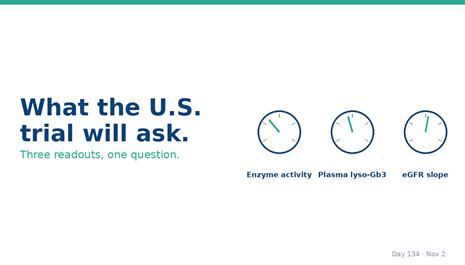
The planned U.S. Phase 1/2 trial is designed to measure alpha-Gal A enzyme activity, plasma lyso-Gb3, and eGFR slope, the same readouts FDA emphasized in its INTERACT feedback. University of Utah Health is planned to be a clinical site. Current planning targets an IND in mid-2027 and first patient enrolled in H1 2028, with a 12-month data readout in 2029.
Interpretation: The core question is wheth...more
Pompe and Gaucher: What 'Preclinical' Means for Programs Two and Three
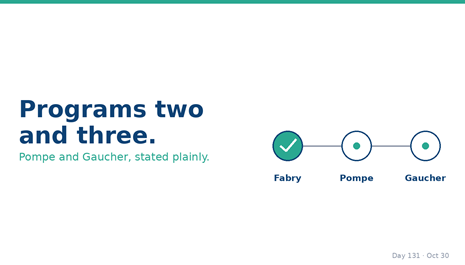
GT-GAA-S04 (Pompe) is preclinical, with efficacy demonstrated in animal models. GT-GBA1-S05 (Gaucher) is in preclinical development in animal models. Both apply the same Live-cel approach as the Fabry program: a patient's own stem cells, corrected with a working copy of the relevant gene (GAA or GBA1).
Interpretation: The value of the two later programs today is platform leverage: shared vector, p...more
Why Does an Autologous Therapy Need a Closed, Automated Manufacturing Process?
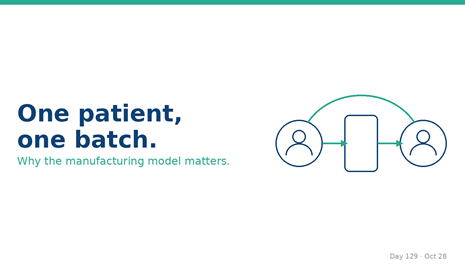
Every Live-cel dose starts with the patient's own stem cells, so each batch is made for one person. FDA's INTERACT feedback identified finalizing potency assays and release specifications, and running a GMP manufacturing campaign under a closed process, as remaining work before an IND. FDA also confirmed CMC knowledge (vector backbone, packaging system, process steps) can be leveraged across our F...more
Orphan Drug Designation and RMAT: What Each Does, and Doesn't, Mean
GT-GLA-S03 holds FDA Orphan Drug Designation, which recognizes Fabry as a rare disease and provides development incentives, including potential market exclusivity if the product is approved. RMAT (Regenerative Medicine Advanced Therapy) designation is separate: it requires preliminary clinical evidence that a regenerative therapy may address an unmet need in a serious condition. Our current plan t...more
Where Would Live-cel Fit Among Today's Fabry Treatments?
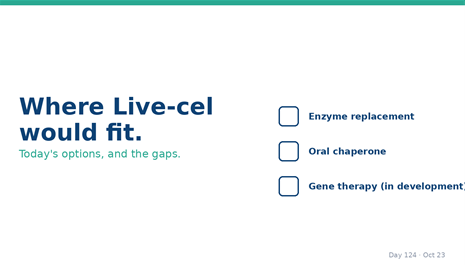
Enzyme replacement therapy is the standard of care: an IV infusion about every two weeks, for life. Roughly 40% of ERT patients develop anti-drug antibodies over time, which can reduce its effectiveness, and ERT does not fully reach every tissue, notably the heart and nervous system. Oral chaperone therapy (migalastat) works only for the roughly 35-50% of patients with an amenable GLA variant. AAV...more
Meet Dr. Ronan Foley, MD: Co-Founder and Transplant Specialist
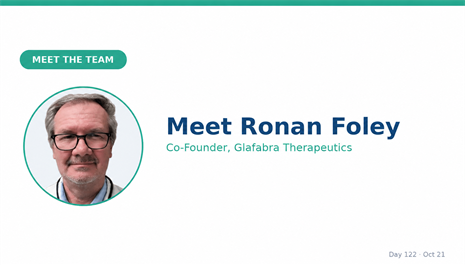
Dr. Ronan Foley, MD, is a Co-Founder of Glafabra and a transplant specialist.
With co-founder Dr. Jeffrey Medin, he co-led the Canadian FACTS trial (NCT02800070), which followed five Fabry patients for five years, including the non-myeloablative, melphalan-based conditioning that allowed 4 of 5 patients to go home the same day.
For diligence purposes: the clinician who led the pilot study's transp...more
What Are the Known Risks of Lentiviral Stem Cell Gene Therapy?
The main recognized risks of lentiviral HSC gene therapy are (1) insertional risk: the vector integrates into the genome, and in rare cases in the wider field, integration has been linked to abnormal cell growth; (2) conditioning risk: the chemotherapy used to make room for corrected cells carries its own side effects; and (3) procedure risk from stem cell collection and re-infusion. In FACTS, ins...more