Content reflects the views of the posting party and is provided for informational purposes only. It does not constitute a solicitation, recommendation, endorsement, or investment advice by BioTech Funding Portal. All content is subject to the portal’s Community Content Guidelines.

Why AAV Gene Therapy for Fabry Disease Can't Be Repeated
 Glafabra
The AAV-waned patient population isn't hypothetical anymore — it's showing up in Glafabra's inbox.
Every AAV gene therapy for Fabry disease triggers a permanent neutralizing antibody response after the first dose, so when expression eventually fades — usually three to five years in — there's no way to re-treat with that same modality. One patient enrolled in an AAV trial has already been referred ...more

What Are Anti-Drug Antibodies in Enzyme Replacement Therapy? — DECODE No. 16
(Answer to the question last time on August 24: roughly 35 to 50 percent of Fabry patients carry an amenable GLA variant that responds to oral chaperone therapy.)
Patients on long-term enzyme replacement therapy can develop something that works against the very treatment they're relying on.
What does the body build up against ERT over time that can reduce how well it works? Drop your guess in the ...more

Lessons from a prior obesity company: what Zafgen taught me about development risk
In late 2005 I founded my first company, an obesity drug developer called Zafgen. This was still long before the highly weight-negative GLP-1 drugs like Ozempic became available. No truly effective drugs for obesity were available at the time, and those that were (like sibutramine and orlistat) had their own challenges with safety and side effects that limited their success. The need for new agent...more

Designing One Clinical Trial for Two Regulators: FDA and PMDA
Designing a trial for two regulators at once is harder than designing it for one — but it's cheaper than doing it twice.
Glafabra's U.S. Phase 1/2 protocol is being built from the outset to generate the specific biomarker package — alpha-Gal A enzyme activity, plasma lyso-Gb3, eGFR slope — that PMDA would require for a Japan submission. That's a deliberate choice made now, months before IND filing...more
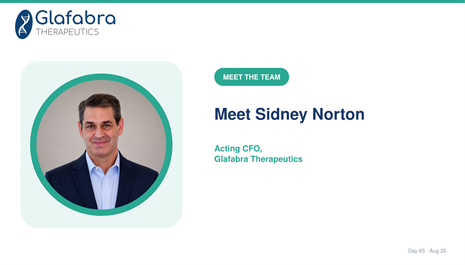
Meet Glafabra's Acting CFO, Sidney Norton
Meet Sidney (Sid) Norton, Acting Chief Financial Officer.
Sid brings 25 years across private, government, and not-for-profit healthcare finance. He currently serves as CFO of Intermountain Primary Children's Hospitals, and previously held senior financial and operational roles at Cincinnati Children's, including VP of the Cancer and Blood Diseases Institute, plus five years in system finance at In...more

What Percentage of Fabry Patients Can Take Oral Therapy? — DECODE No. 15
(Answer to the question last time on August 20: lupus, multiple sclerosis, and other conditions with overlapping symptoms are common Fabry misdiagnoses.)
There's an oral therapy for Fabry disease, but it only works for patients whose specific GLA variant responds to it.
Roughly what percentage of Fabry patients carry a variant that qualifies for oral therapy? Drop your guess in the comments below.
...more
Six Weeks Into Testing the Waters: Glafabra's Progress Update
Six weeks into Testing the Waters. Here's where things actually stand.
FDA INTERACT meeting: done. IND protocol: in development. University of Utah Health: planned to be the primary clinical site. DECODE has answered 13 real questions about Fabry disease so far, and our LinkedIn Tuesdays are now team introductions.
If you've been reading since Day 1 — thank you. If you just found us — welcome, and...more

Ask Glafabra Anything: Live Q&A on the BioTech Funding Portal
This portal is a live Q&A, not a static page.
Questions we've gotten recently: Why did Glafabra choose melphalan over busulfan for conditioning? What happens to the corrected cells over the long term? Why is University of Utah Health planned to be the clinical site?
We answer every one publicly so the whole community benefits from the answer, not just the person who asked.
What's your question...more