Content reflects the views of the posting party and is provided for informational purposes only. It does not constitute a solicitation, recommendation, endorsement, or investment advice by BioTech Funding Portal. All content is subject to the portal’s Community Content Guidelines.
How Glafabra's Platform IP Covers Fabry, Pompe, and Gaucher Disease
 Glafabra
One platform, three diseases, and a body of intellectual property built to protect all three at once.
Glafabra's patent position covers the Live-cel approach across its lysosomal storage disorder programs — Fabry (GT-GLA-S03), Pompe (GT-GAA-S04), and Gaucher (GT-GBA1-S05) — because the underlying platform (correct the HSC, let cross-correction do the rest) is the same regardless of which gene gets...more
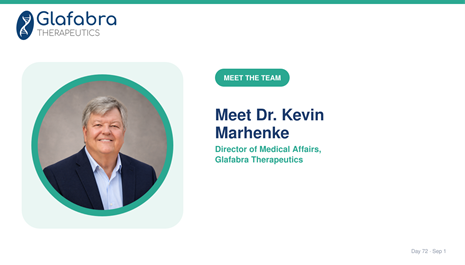
Meet Glafabra's Director of Medical Affairs, Dr. Kevin Marhenke
Meet Dr. Kevin Marhenke, PharmD, Director of Medical Affairs.
Kevin brings more than four decades in pharmaceutical and biotech leadership — hospital pharmacy, medical affairs, external engagement, and strategy. He held senior roles at Immunex and Amgen, leading market introduction for Enbrel, Prolia, EVENITY, and biosimilars, and later served as Amgen's Director of Global External Engagement acro...more

Where Does Early Fabry Disease Pain Usually Occur? — DECODE No. 17
(Answer to the question last time on August 27: roughly 40 percent of ERT patients develop anti-drug antibodies over time, which can reduce how well the infused enzyme works.)
It's often the very first symptom Fabry patients notice, frequently in childhood — a burning, tingling pain in a specific part of the body.
Where in the body does this early, telltale Fabry pain usually show up? Drop your gu...more
Why Rare Diseases Like Fabry Stay Underfunded by Big Pharma
A pharma company will almost always choose a blockbuster over a small patient population. That's not cynicism — it's how the economics of a multibillion-dollar portfolio actually work.
It's also exactly why rare diseases like Fabry, Pompe, and Gaucher stay underserved relative to their severity, and why community funding models — ours included — exist at all. A therapy addressing a few thousand pe...more

Why Fabry Disease Requires a Multidisciplinary Care Team
Fabry disease touches the kidneys, heart, nerves, skin, and GI tract — so no single specialist manages it alone.
Patients typically see a rotating team: a metabolic or genetics specialist, a nephrologist, a cardiologist, a neurologist, sometimes a pain specialist. Coordinating all of that is its own quiet burden on patients and families.
Glafabra's own team mirrors that same instinct toward breadt...more

Why AAV Gene Therapy for Fabry Disease Can't Be Repeated
The AAV-waned patient population isn't hypothetical anymore — it's showing up in Glafabra's inbox.
Every AAV gene therapy for Fabry disease triggers a permanent neutralizing antibody response after the first dose, so when expression eventually fades — usually three to five years in — there's no way to re-treat with that same modality. One patient enrolled in an AAV trial has already been referred ...more

What Are Anti-Drug Antibodies in Enzyme Replacement Therapy? — DECODE No. 16
(Answer to the question last time on August 24: roughly 35 to 50 percent of Fabry patients carry an amenable GLA variant that responds to oral chaperone therapy.)
Patients on long-term enzyme replacement therapy can develop something that works against the very treatment they're relying on.
What does the body build up against ERT over time that can reduce how well it works? Drop your guess in the ...more

Lessons from a prior obesity company: what Zafgen taught me about development risk
In late 2005 I founded my first company, an obesity drug developer called Zafgen. This was still long before the highly weight-negative GLP-1 drugs like Ozempic became available. No truly effective drugs for obesity were available at the time, and those that were (like sibutramine and orlistat) had their own challenges with safety and side effects that limited their success. The need for new agent...more