Content reflects the views of the posting party and is provided for informational purposes only. It does not constitute a solicitation, recommendation, endorsement, or investment advice by BioTech Funding Portal. All content is subject to the portal’s Community Content Guidelines.

One Month After Glafabra's FDA INTERACT Meeting
 Glafabra
One month since Glafabra's FDA INTERACT meeting.
That July 16 conversation shapes the IND protocol we're building now: endpoint strategy, patient selection criteria, conditioning approach. None of that gets finalized overnight — it's weeks of translating regulatory feedback into a protocol document.
For those tracking the timeline: IND filing stays targeted for mid-2027. First patient enrolled tar...more

Can Fabry Disease Occur With No Family History? — DECODE No. 12
Answer to the question last time on August 10: a father passes his only X chromosome to every daughter and his Y to every son — so every daughter inherits his Fabry variant, and no son does.)
Most Fabry cases run in families. But every so often, someone is diagnosed with zero family history at all — no parent, no sibling, nothing in the records.
What causes Fabry disease to show up with no family ...more
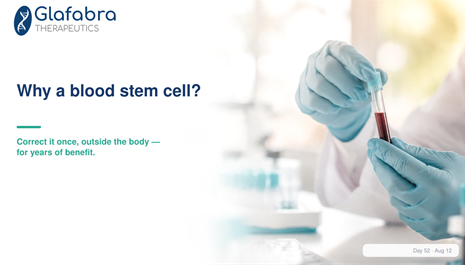
Why Does Live-cel Use Hematopoietic Stem Cells?
Why build a gene therapy around a blood stem cell instead of a virus alone?
A hematopoietic stem cell (HSC) — the cell that gives rise to your entire blood and immune system — can be corrected once, outside the body, and then put back in. It engrafts permanently, and its corrected descendants keep making the missing enzyme for years.
That's the foundation Live-cel is built on: harvest, correct, re...more
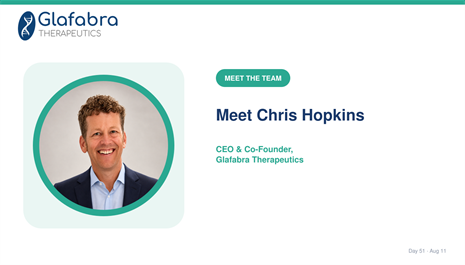
Meet Glafabra's CEO & Co-Founder, Chris Hopkins
Meet the person leading this: Chris Hopkins, CEO & Co-Founder.
Chris is a geneticist, biochemist, and entrepreneur who's spent his career at the intersection of science and company-building. He guided the acquisition of Knudra Transgenics by InVivo Biosystems, raised over $5M in venture capital and $7M in non-dilutive SBIR funding, licensed CRISPR technology in 2014 — shortly after it was inve...more

Why Do All Daughters of an Affected Father Inherit Fabry Disease? — DECODE No. 11
(Answer to the question last time on August 6: Fabry disease is X-linked — the GLA gene sits on the X chromosome, so the pattern plays out differently for men and women.)
Here's the quirk that surprises people. A father with Fabry disease passes the condition to every single one of his daughters — but to none of his sons.
Why does it break down exactly that way? Drop your guess in the comments bel...more

What's New in Glafabra's Testing the Waters Campaign
One month into Testing the Waters. Here's what's changing for month two.
More real faces. Starting this Tuesday, we're introducing you to the people building Glafabra — one team member at a time, starting with our CEO.
DECODE keeps going, but simpler: no more separate answer-comment days later. Each new riddle now opens with last time's answer, right in the post.
And more of Glafabra's actual stor...more