Content reflects the views of the posting party and is provided for informational purposes only. It does not constitute a solicitation, recommendation, endorsement, or investment advice by BioTech Funding Portal. All content is subject to the portal’s Community Content Guidelines.

What 'Testing the Waters' Actually Means
 Glafabra
Testing the Waters is a formal SEC mechanism under Regulation Crowdfunding that lets a company gauge investor interest before filing a formal offering statement (Form C). No money can be solicited or accepted at this stage, and no offer to buy securities can be made.
That's why every post here carries the full disclosure below, and why registering interest is non-binding -- it's a real, if informa...more

What the Five-Year FACTS Data Does — and Does Not — Show
In the FACTS trial (5 patients, Canada, NCT02800070): a 48% reduction in plasma lyso-Gb3 vs. no-ERT baseline (p<0.0001) at 5-year follow-up; 4 of 5 patients below the lyso-Gb3 threshold at year 5; all 5 maintained durable enzyme expression; zero product-attributable serious adverse events; polyclonal integration with no clonal dominance.
This shows the approach can produce a durable biomarker r...more

What Changed After the First Two Campaign Months
Two months of daily public content. Here's the honest read.
Engagement grew meaningfully once we started introducing the team behind Live-cel and reacting to real industry news, rather than only running scheduled educational content. Our DECODE education series also moved from a manual answer-in-comments format to an integrated Q&A format, based on direct reader feedback.
None of this changes ...more

Two Months, One Platform, Three Diseases: Glafabra's Progress So Far
Two months. One platform. Three diseases. Building in public the whole way.
Fabry, Pompe, and Gaucher disease — three diseases the platform is designed to address by correcting one cell type and swapping in the disease-specific gene. An FDA meeting behind us, an IND protocol taking shape, University of Utah Health planned as the clinical site, and a Japan strategy running in parallel from day one.
...more
Two Months Into Testing the Waters: What's Ahead for Glafabra
Two months of Testing the Waters, almost to the day.
Since June 22: 18 questions answered through DECODE, four members of the Glafabra team introduced in person on LinkedIn, and a real-time record of an FDA meeting, a protocol taking shape, and a Japan strategy moving in parallel with the U.S. one.
What's ahead: more team introductions, continued DECODE questions, and whatever comes out of IFFD an...more

How Common Is Fabry Disease? — DECODE No. 18
(Answer to the question last time on August 31: hands and feet — acroparesthesia, caused by small-fiber nerve involvement, often starting in childhood.)
Fabry disease is rare, but estimates for exactly how rare span a wide range — and most researchers think the real number is higher than any of them.
Roughly how many people are estimated to be born with Fabry disease? Drop your guess in the commen...more
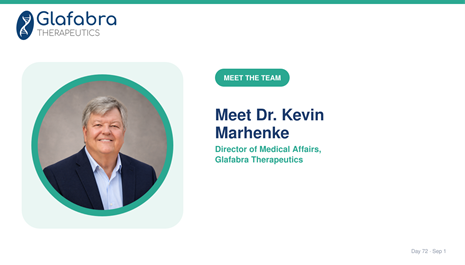
Meet Glafabra's Director of Medical Affairs, Dr. Kevin Marhenke
Meet Dr. Kevin Marhenke, PharmD, Director of Medical Affairs.
Kevin brings more than four decades in pharmaceutical and biotech leadership — hospital pharmacy, medical affairs, external engagement, and strategy. He held senior roles at Immunex and Amgen, leading market introduction for Enbrel, Prolia, EVENITY, and biosimilars, and later served as Amgen's Director of Global External Engagement acro...more

Where Does Early Fabry Disease Pain Usually Occur? — DECODE No. 17
(Answer to the question last time on August 27: roughly 40 percent of ERT patients develop anti-drug antibodies over time, which can reduce how well the infused enzyme works.)
It's often the very first symptom Fabry patients notice, frequently in childhood — a burning, tingling pain in a specific part of the body.
Where in the body does this early, telltale Fabry pain usually show up? Drop your gu...more