Content reflects the views of the posting party and is provided for informational purposes only. It does not constitute a solicitation, recommendation, endorsement, or investment advice by BioTech Funding Portal. All content is subject to the portal’s Community Content Guidelines.
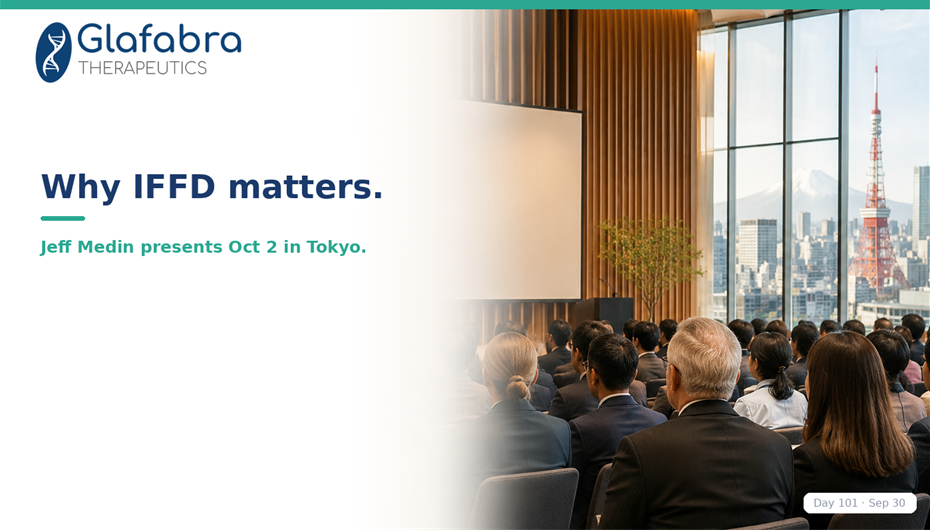
Why the International Fabry Family Day Discussion Matters
 Glafabra
 co-founder Dr. Jeff Medin presents Live-cel data at IFFD 2026, the international Fabry symposium at Jikei University in Tokyo, on October 2.
This puts trial data in front of the specialist community that diagnoses and manages Fabry patients directly -- a different, and in some ways more demanding, audience than investors or the general public.
We'll report what was actually discussed and ...more
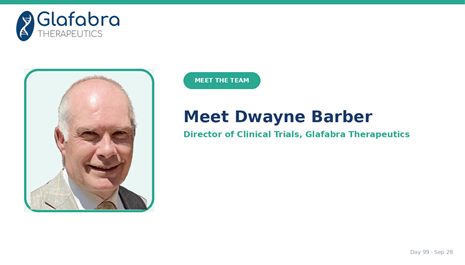
Meet Dr. Dwayne Barber, PhD — Director of Clinical Trials
Dwayne is Professor Emeritus at the University of Toronto, author of more than 70 papers on hematopoietic signalling, leukemia, and lysosomal storage disorders, and served as project manager for the Phase 1 trial that first used gene therapy to treat Fabry disease -- the pilot work behind Glafabra's FACTS data.
He brings direct experience with the regulatory challenges specific to cell and gene th...more
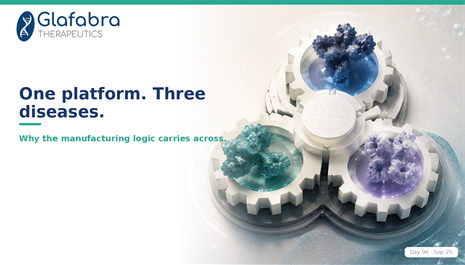
Why Fabry, Pompe, and Gaucher Share Platform Leverage
Fabry, Pompe, and Gaucher disease are each caused by a different missing lysosomal enzyme, but treated with the same underlying approach: correct a patient's own hematopoietic stem cells ex vivo, then re-infuse them. FDA's INTERACT feedback confirmed CMC knowledge -- vector backbone, packaging system, process steps -- can carry across programs where those elements are conserved.
That's the basis f...more
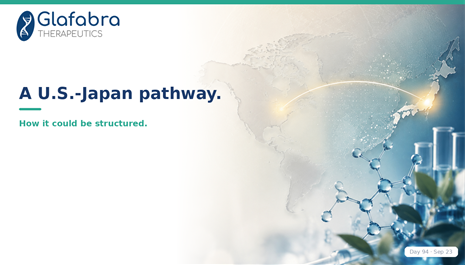
How a U.S.-Japan Pathway Could Be Structured
The clinical data package FDA asked for in INTERACT feedback (alpha-Gal A activity, plasma lyso-Gb3, eGFR slope) is largely the same package Japan's PMDA would want to see for a parallel review. Glafabra is building Japan pharma and academic relationships (via IFFD, BIO Japan, and direct outreach) in parallel with the U.S. trial, rather than sequencing Japan after U.S. approval.
Done well, this co...more
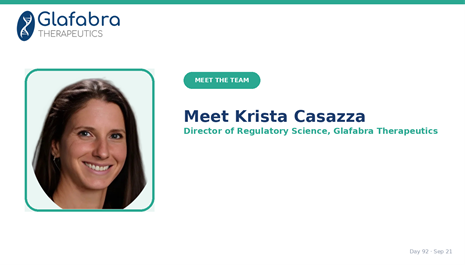
Meet Dr. Krista Casazza, PhD — Director of Regulatory Science
Krista most recently served as Scientific Director at the Critical Path Institute, leading biomarker discovery for lysosomal storage disorders for inclusion in FDA trials.
She previously held research leadership roles at Florida Gulf Coast University and the University of Alabama at Birmingham's Department of Pediatrics.
At Glafabra, she leads the regulatory science translating our data into the e...more
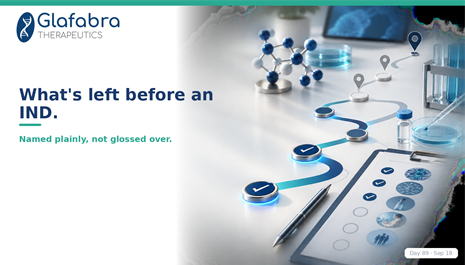
What Work Remains Before an IND
Per FDA's INTERACT feedback, remaining work includes finalizing potency assays and release specifications, running a GMP manufacturing campaign under a closed process, completing additional nonclinical characterization FDA requested, and holding a Pre-IND meeting.
None of this is unusual for a pre-IND cell and gene therapy program -- this is the standard pathway, informed directly by regulator fee...more

Why Same-Day Outpatient Conditioning Matters
4 of 5 FACTS trial patients received their conditioning regimen and went home the same day, using a non-myeloablative, melphalan-based approach rather than bone-marrow-transplant-intensity chemotherapy.
For patients, that's materially less treatment burden. For the development program, it's also a differentiator from more intensive HSC-gene-therapy conditioning approaches used elsewhere in the fie...more
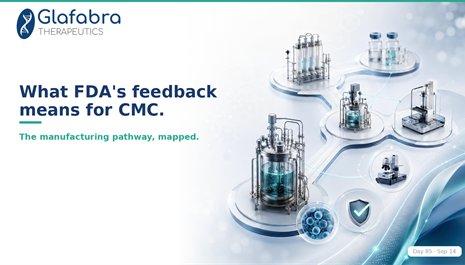
What FDA's INTERACT Feedback Means for the CMC Pathway
FDA's written INTERACT feedback (following the July 16 meeting) noted our nonclinical data support a proposed early, exploratory clinical study, recommended plasma lyso-Gb3 as the primary pharmacodynamic readout, endorsed at least two years of eGFR follow-up, and confirmed CMC knowledge (vector backbone, packaging system, process steps) can be leveraged across Glafabra's Fabry, Pompe, and Gaucher ...more