Content reflects the views of the posting party and is provided for informational purposes only. It does not constitute a solicitation, recommendation, endorsement, or investment advice by BioTech Funding Portal. All content is subject to the portal’s Community Content Guidelines.

What Are the Known Risks of Lentiviral Stem Cell Gene Therapy?
 Glafabra
The main recognized risks of lentiviral HSC gene therapy are (1) insertional risk: the vector integrates into the genome, and in rare cases in the wider field, integration has been linked to abnormal cell growth; (2) conditioning risk: the chemotherapy used to make room for corrected cells carries its own side effects; and (3) procedure risk from stem cell collection and re-infusion. In FACTS, ins...more

Is There a Cure for Fabry Disease?
here is currently no approved cure for Fabry disease. Approved treatments, enzyme replacement therapy (an IV infusion about every two weeks) and, for patients with an amenable GLA variant, an oral chaperone (migalastat), manage the disease. Several gene therapy approaches aiming for durable enzyme production are in clinical development.
Interpretation: Live-cel (GT-GLA-S03) is one of those approac...more
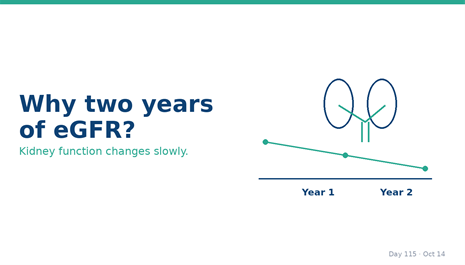
Why Did FDA Recommend at Least Two Years of eGFR Follow-Up?
eGFR (estimated glomerular filtration rate) measures kidney function. Kidney involvement (Fabry nephropathy) is one of the main ways the disease progresses. In its INTERACT feedback, FDA recommended at least two years of eGFR follow-up for GT-GLA-S03.
Interpretation: eGFR changes slowly, so a short study can't tell a meaningful trend from normal variation. Two years is the minimum window to see wh...more
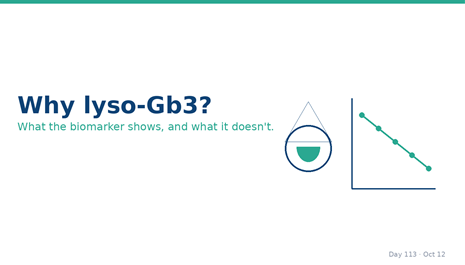
Why Is Plasma Lyso-Gb3 the Primary Readout, and What Can't It Tell You?
Lyso-Gb3 is the circulating derivative of Gb3, the lipid that builds up when alpha-Gal A is deficient, and the main blood biomarker used to track Fabry disease activity. In FDA's written INTERACT feedback, plasma lyso-Gb3 was recommended as the primary pharmacodynamic readout for GT-GLA-S03. In the FACTS trial, plasma lyso-Gb3 fell 48% vs. no-ERT baseline (p<0.0001) at 5-year follow-up, with 4 ...more
What We Heard at BIO Japan
Evidence: From October 7 to 9, Glafabra took part in BIO Japan in Yokohama, one of Asia's largest biotech partnering events. The team was there for two kinds of conversations: manufacturing and analytical development partners with experience in autologous lentiviral stem-cell therapy, and Japan-based pharma and academic groups working in lysosomal storage disorders. Both follow from FDA's INTERACT...more
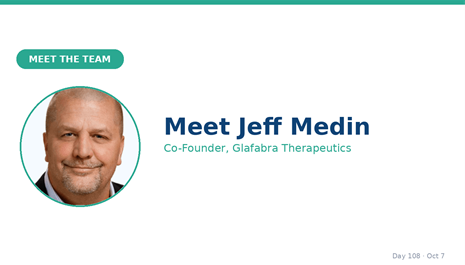
Meet Dr. Jeffrey Medin, PhD: The Scientist Behind Live-cel
Dr. Jeffrey Medin, PhD, is a Co-Founder of Glafabra and the principal inventor of the Live-cel platform.
With co-founder Dr. Ronan Foley, he led the Canadian FACTS trial (NCT02800070), which followed five Fabry patients for five years and produced the published data Glafabra is built on (PMID 36816757). On October 2 he presented at IFFD 2026 at Jikei University in Tokyo.
For diligence purposes: th...more

What Glafabra Is Seeking at BIO Japan
At BIO Japan (Yokohama, Oct 7-9), Glafabra is seeking two kinds of partners: manufacturing partners (CDMOs, analytical development groups, vector partners experienced in autologous lentiviral stem-cell therapy) and Japan pharma partners interested in a licensing/co-development conversation for Glafabra's LSD programs.
This follows directly from FDA's INTERACT feedback pointing toward a defined CMC...more
What We Heard at IFFD
This is exactly the kind of scrutiny a rare-disease gene therapy program should welcome before it reaches a larger trial.
Follow the whole series: https://bit.ly/Glafabra-TTW
@Brian Christie @Neva West @Brian Christie @Tetsu Yung
Testing the Waters disclosure: We are considering a capital raise and are "Testing the Waters" under Regulation Crowdfunding. No money or other consider...more